Glass Discs that Last Billions of Years: The Future of Data Storage
Revolutionary 5D Memory Crystal technology stores 360TB on glass discs that survive billions of years, nuclear radiation, and extreme temperatures - the ultimate data storage solution.
Scout Team
# Glass Discs that Last Billions of Years: The Future of Data Storage
In the ever-evolving world of data storage, a groundbreaking technology has emerged that could redefine the way we think about long-term preservation. Introducing the 5D Memory Crystal, a revolutionary data storage solution that offers an astonishing level of resilience and capacity that makes today's SSDs and hard drives look like ancient technology.
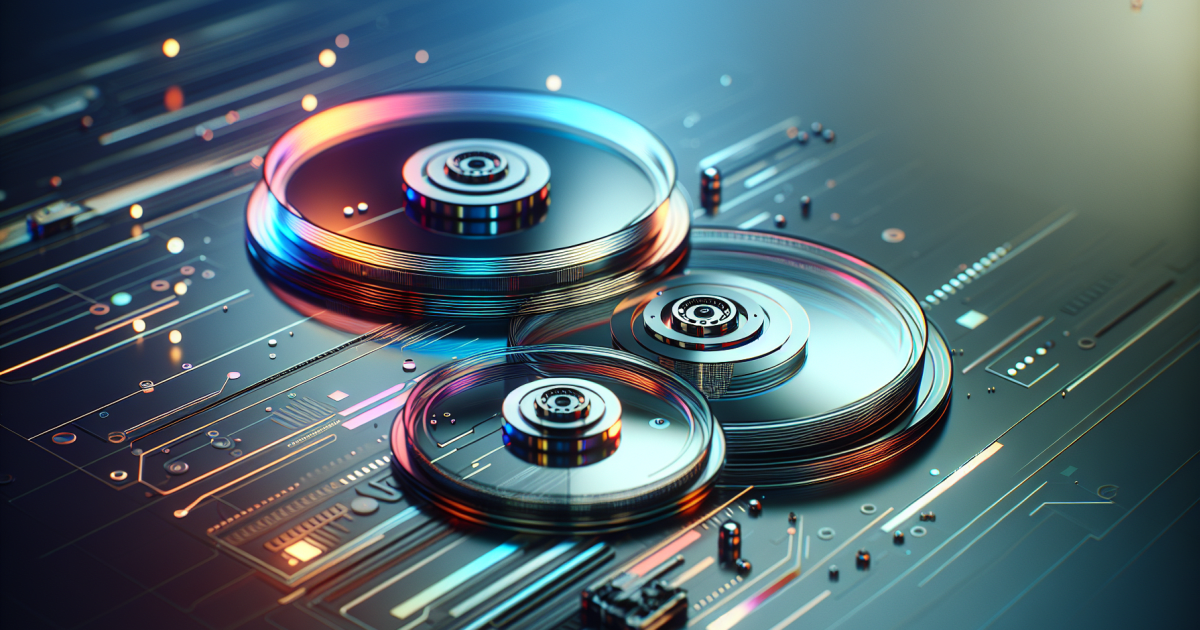
Developed by SPhotonix, this innovative technology harnesses the power of femtosecond lasers to etch data onto glass discs, creating a 5D storage medium that is incredibly durable. Unlike traditional storage methods, these glass discs can withstand extreme temperatures, electromagnetic fields, and even nuclear radiation, making them an ideal choice for safeguarding critical information for millennia.
What's truly remarkable about the 5D Memory Crystal is its staggering storage capacity. A single 5-inch glass disc can store up to 360 terabytes of data – that's enough to store the contents of the entire British Library, with room to spare. But the real kicker is the longevity of this storage solution, with data retention capabilities extending up to **13.8 billion years** at room temperature.
How 5D Memory Crystal Technology Works
To understand why this technology is so revolutionary, we need to dive into the science behind it. Traditional storage methods rely on magnetic fields (hard drives) or electrical charges (SSDs) to store data. The 5D Memory Crystal takes a fundamentally different approach.
The Five Dimensions of Data Storage
The "5D" in 5D Memory Crystal refers to five different properties used to encode information:
This multi-dimensional approach allows for incredibly dense data packing, far exceeding what's possible with conventional binary storage methods.
Femtosecond Laser Precision
The creation process involves ultra-short pulse lasers that fire for just femtoseconds (10^-15 seconds). These incredibly brief but intense pulses create tiny nanostructures within the glass substrate without damaging the surrounding material. Each pulse creates what researchers call "optical voxels" – three-dimensional pixels that can store multiple bits of information.
The precision required is staggering: the laser must accurately target points within the glass with nanometer precision, creating structures smaller than the wavelength of visible light.
Real-World Applications and Use Cases
Enterprise and Data Centers
For enterprise users dealing with massive datasets, 5D Memory Crystals represent a paradigm shift in archival storage:
Government and National Archives
Governments worldwide are already exploring this technology for preserving cultural heritage and critical documents. The Vatican Secret Archives and the British Library have expressed interest in migrating their most precious documents to this format.
Gaming and Entertainment Industry Applications
While primarily designed for archival purposes, this technology has intriguing implications for the gaming industry:
Technical Specifications and Performance
Storage Capacity Breakdown
| Disc Size | Storage Capacity | Equivalent To |
|-----------|-----------------|---------------|
| 2.5 inches | 144 TB | ~28,800 Blu-ray discs |
| 5 inches | 360 TB | ~72,000 Blu-ray discs |
| Theoretical max | 1+ PB | Limited by reading technology |
Durability Testing Results
Extensive testing has demonstrated the crystal's resilience:
Current Limitations and Challenges
Write Speed Constraints
The biggest limitation currently facing 5D Memory Crystal technology is write speed. Creating the nanoscale structures requires precise laser etching, which is inherently slower than electronic writing methods:
Cost Considerations
The sophisticated equipment required for both writing and reading these crystals represents a significant investment:
Reading Technology Requirements
Accessing data from 5D Memory Crystals requires specialized optical reading equipment, making it incompatible with standard computer systems without additional hardware.
Market Availability and Pricing
As of December 2025, 5D Memory Crystal technology is primarily available through specialized data preservation companies and research institutions. SPhotonix offers several service tiers:
Commercial Services
Future Consumer Prospects
While not yet practical for consumer use, industry analysts predict that simplified versions could become available for high-end users by 2030, potentially targeting:
Comparison with Traditional Storage Methods
Longevity Comparison
Capacity Density
The 5D Memory Crystal achieves unprecedented data density:
The Environmental Impact
One often overlooked advantage of 5D Memory Crystal technology is its environmental friendliness:
Future Developments and Roadmap
Researchers and engineers continue pushing the boundaries of this technology:
Near-term Improvements (2026-2028)
Long-term Vision (2030+)
FAQ
What makes 5D Memory Crystals different from regular optical storage?
Unlike CDs or Blu-rays that store data on the surface using pits and lands, 5D Memory Crystals encode information throughout the entire volume of the glass using five different optical properties. This allows for much higher storage density and extraordinary durability – they can survive extreme temperatures, radiation, and electromagnetic fields that would destroy conventional optical media.
Can I use 5D Memory Crystals with my current computer setup?
Currently, no. Reading data from 5D Memory Crystals requires specialized optical equipment that uses polarized light microscopy and advanced imaging systems. The technology is primarily available through professional data preservation services rather than consumer hardware. However, simplified reading devices may become available for high-end users in the coming years.
How much does it cost to store data on a 5D Memory Crystal?
As of 2025, costs range from $10-100 per gigabyte depending on the volume and service provider. While expensive compared to traditional storage, the cost becomes economical when you consider the multi-billion-year lifespan and zero maintenance requirements. For organizations needing to preserve data for decades or centuries, the total cost of ownership can actually be lower than traditional methods.
Is the data really safe for billions of years?
Laboratory testing suggests yes, though obviously we can't test for billions of years directly. Researchers use accelerated aging tests at high temperatures to simulate long-term degradation. The nanostructures created in the glass are extremely stable, and the testing indicates data retention of 13.8 billion years at room temperature – longer than the current age of the universe. The main limitation would likely be the availability of reading technology in the distant future.