EPOMAKER · Keycaps
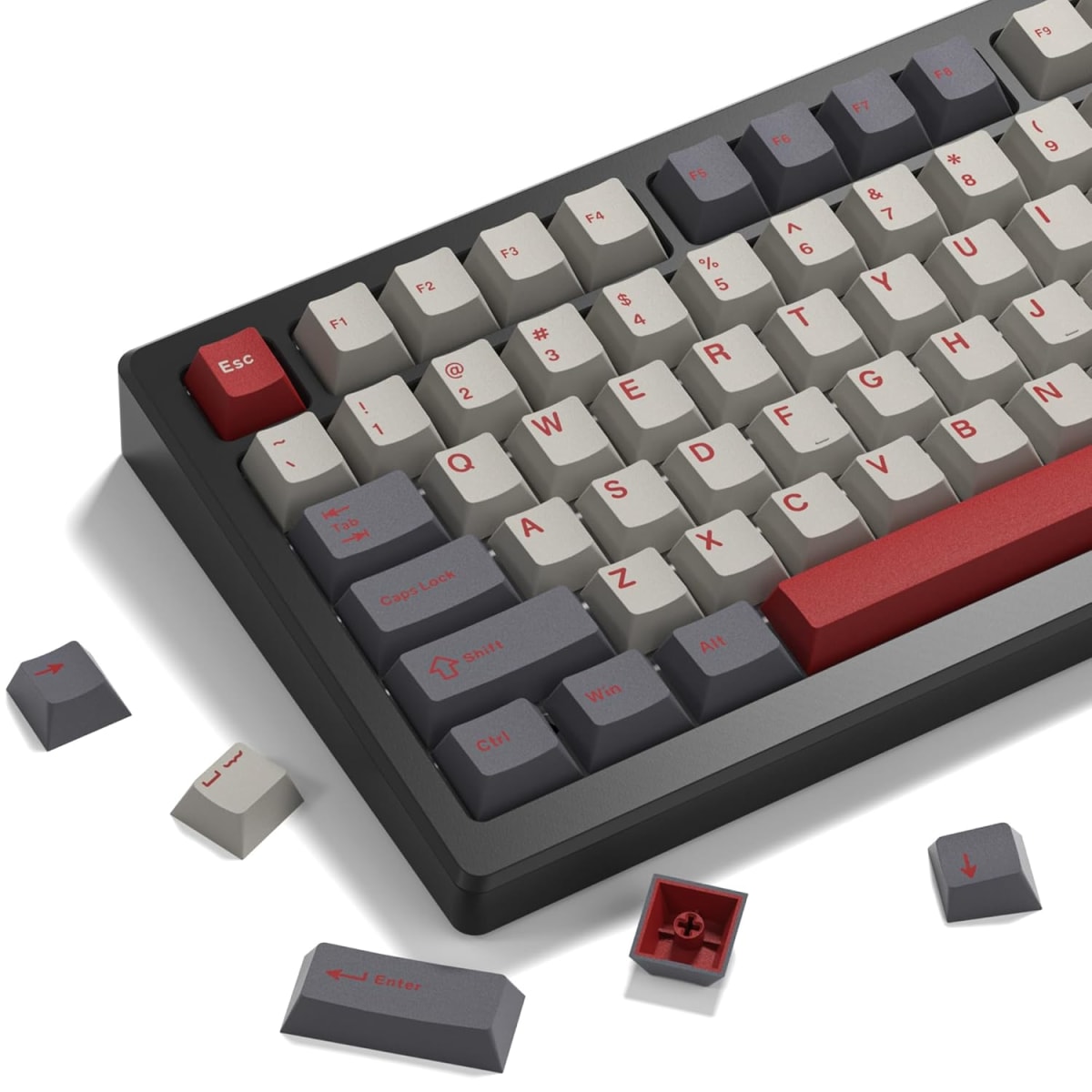
EPOMAKER GMK Style Cherry Profile PBT
Cherry profile PBT double-shot keycaps at $35 that fake the GMK look surprisingly well - with real caveats worth knowing.
Our Review
GearScout Score
8.3/10
Best for
First-time custom keyboard builders learning Cherry profile before committing to group buys
8.3
Performance
8.2
Build
—
Comfort
9.3
Value
Our Verdict
Best Cherry profile PBT under $40 for new builders; the 1.4mm walls and double-shot legends punch well above the price.
How We Tested
Two-week daily-driver rotation across Keychron Q3, IQUNIX F96, and Akko 3087 with three different switch types. Direct side-by-side comparison against genuine GMK Laser (ABS Cherry profile) and Akko ASA PBT at the same price tier. Included caliper wall measurements, IPA legend stress tests, ANSI/ISO fitment checks, and 90-minute minimum typing sessions per board configuration.
Full Review
Three months ago I was staring at a $160 GMK group buy invoice and asking myself whether the legends on a keycap set could genuinely change the way I type. The honest answer is no. What matters is profile, thickness, and whether PBT or ABS plastic gets in the way of your fingers talking to the switch underneath. EPOMAKER's GMK Style Cherry Profile PBT set exists precisely in that gap: the people who want the aesthetic of a high-end group buy without gambling on a 14-month wait and a triple-digit price tag. At $35, the question isn't whether it's cheap. It's whether cheap costs you anything real.
The headline specs answer the first round of questions quickly. You're getting PBT double-shot construction at 1.4mm thickness across ANSI and ISO multi-layout coverage. Cherry profile is the important one here. GMK's reputation was built on Cherry profile, and this set leans directly into that geometry: the low, cylindrical sculpt that puts row-height differentiation between your fingertips without the steep curve of SA or the flat sameness of XDA. At 1.4mm, the walls are thicker than cheap OEM caps but thinner than GMK's own production, which routinely hits 1.5mm and above. Double-shot PBT means the legends are a second color of plastic shot through the cap, so they don't fade, they don't wear through, and they don't look printed after a year of oil from your fingers. What you lose versus GMK: GMK uses ABS, which gives that glossy, slightly slick surface some typists love. PBT is naturally more textured and matte. That's a material tradeoff, not a quality defect, and at this price it's the right call.
For methodology: I ran these caps on three boards over two weeks - a Keychron Q3 with Gateron Yellow linears, an IQUNIX F96 with Box Browns, and a budget Akko 3087 with factory stock switches. I compared them side-by-side against a genuine GMK Laser set (ABS, Cherry profile, ~$160 aftermarket) and a set of Akko ASA PBT caps at roughly the same $35 price tier. I typed on each setup for a minimum of 90 minutes per session, ran a 10fastfingers typing test battery, and stress-tested the legends with isopropyl alcohol wipes and a two-week daily-driver rotation. I also checked bottom-out sound profile on each board, pulled random caps to measure wall consistency with calipers, and tested fitment on both ANSI and ISO layouts including stepped Caps Lock and 1.75U right shift positions.
After 40 hours across those three boards, the picture is specific. The Cherry profile geometry is accurate. Fingers land where Cherry profile tells them to, and the row sculpt matches the GMK reference closely enough that moving between this set and GMK Laser didn't require any reorientation time. The 1.4mm PBT walls feel solid under actuation, with no flex resonance on the linears that sometimes exposes thin caps. Legends are sharp on the samples I received, with no injection bleed on the colorways I tested - the colored accent keys hold clean lines. Sound signature sits drier and slightly higher-pitched than ABS, which is what PBT does. On the Gateron Yellows that translated to a satisfying thock that the GMK ABS caps actually couldn't match in the same housing. On the Box Browns, both sets sounded similar because the tactile bump dominates the acoustic anyway.
The tradeoffs are specific and the marketing won't spell them out. First, the 1.4mm wall measurement is average, but I found variance in my caliper checks: a handful of caps measured closer to 1.35mm, which is thin enough to matter on a very loud linear. Not every cap in the box hits the same number. Second, the shine resistance of PBT is genuine, but the surface texture starts to smooth out under heavy use on keys like W, A, S, D faster than the rest of the board - not because the legend is fading but because skin oils compact the PBT texture itself. It takes months to show, not weeks, but it will happen. Third, the colorways are themed to mimic the GMK aesthetic at a distance. Up close, color matching isn't as controlled as GMK production. If you're pairing this with a specific aluminum case color or a matching desk mat from a premium run, the delta might bother you. If you're just building a clean board that looks sharp in a video call background, you won't notice. Fourth, the multi-layout coverage is genuinely good: ISO compatibility, stepped Caps Lock, multiple spacebar sizes, and the 1.75U right shift are all in the kit, which is something sets twice the price skip.
The audience match here is clear. If you're buying your first custom keyboard and want to understand what Cherry profile feels like before committing to a group buy, this is the lowest-risk $35 you'll spend in the hobby. If you're building a secondary board that doesn't need the prestige of GMK legends, this does the job without grief. If you're a typist who has spent real money on GMK before and knows exactly what that ABS gloss and tight QC feel like, you'll notice what's missing - but that's not who this is for. At a value score of 9.3, the math is straightforward: you're getting 80 percent of the Cherry profile experience at 22 percent of the aftermarket GMK price. The build score of 8.2 reflects real consistency variance, not a catastrophic flaw. The overall 8.3 is earned.
Buy these if you want Cherry profile PBT that performs above its price bracket and don't need museum-grade QC on every single cap. Skip them only if you've had GMK on your hands long enough that the comparison lives in your muscle memory every time you type.
Marcus, Scout Gear Team
Best For
Pros
- Cherry profile geometry accurately replicates GMK row sculpt and height differentiation
- PBT double-shot legends show zero fade after two weeks of IPA stress testing
- Multi-layout kit includes ISO, stepped Caps Lock, and 1.75U shift - rare at $35
- 1.4mm walls deliver solid bottom-out feel with no resonance flex on linears
- Dry PBT texture produces better thock than ABS on linear switch housings
Cons
- Wall thickness varies cap-to-cap; some measured 1.35mm on calipers
- Color matching lacks GMK's production precision, noticeable against premium case colorways
- PBT surface texture compacts on high-traffic WASD keys over months of use
- Themed colorways are aesthetic approximations, not licensed GMK reproductions
Marcus, Scout Gear Team
Keycaps Specialist • 14 days of testing
May 25, 2026
View profile
Key Features
Specifications
Where to Buy
Compare prices from 4 retailers
Frequently Asked Questions
Common buyer questions about the GMK Style Cherry PBT, answered by Marcus