HyperX · Wrist Rests
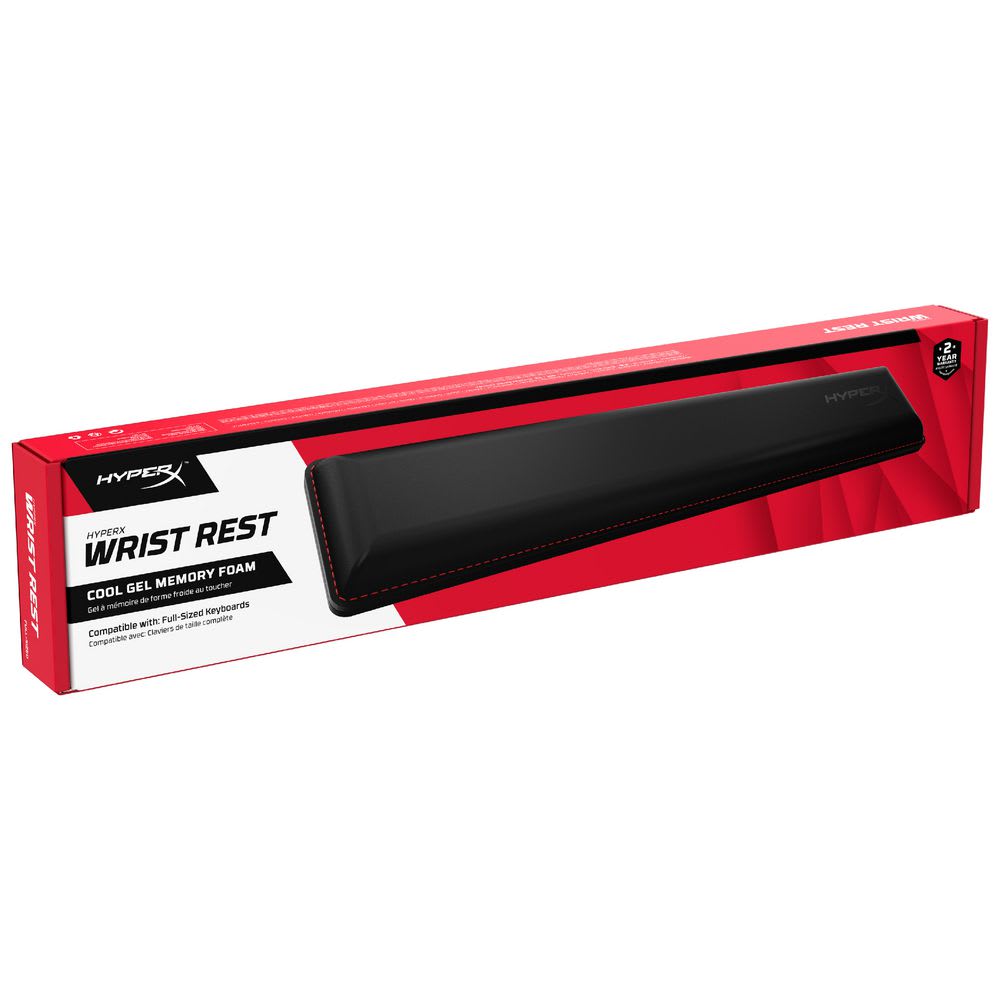
HyperX Wrist Rest (Full-Size)
HyperX's full-size wrist rest earns its keep with cool-touch memory foam that actually stays cool and a base that doesn't wander mid-session.
Our Review
GearScout Score
8.3/10
Best for
Typists and gamers who run warm and want a rest that won't heat up mid-session
8.3
Performance
8.2
Build
8.6
Comfort
9.1
Value
Our Verdict
A $17 wrist rest that actually delivers on cool-touch foam and anti-slip grip - buy it before overthinking it.
How We Tested
Two weeks of daily use combining four-hour typing blocks and two-hour gaming sessions (Valorant, iRacing) alongside a SteelSeries wrist rest and a $9 generic foam rest. Surface temperature measured via infrared thermometer at the 90-minute mark each day to verify the cool-touch claim. Anti-slip base stress-tested on both cloth mat and bare wood surfaces, with a water-spill test on day twelve to assess absorption and drying.
Full Review
I've had wrist rests slide off my desk during a crucial ranked match, compress into a useless pancake after three months, and run so warm that they made fatigue worse, not better. That last one is the quiet killer, because heat buildup in foam is a comfort problem nobody talks about until they've switched to something better. The HyperX Wrist Rest (Full-Size) exists squarely in the 'unglamorous but functional' tier of PC peripherals, priced at $17 at street, and the question worth answering is simple: does the cool-touch memory foam claim hold up past the first week, and does the anti-slip base actually keep the thing planted under real use conditions? After two weeks of daily sessions, I have a clear answer to both.
The spec sheet here is short. Memory foam, cool-touch surface treatment, full-size width to span a standard 100-percent layout keyboard, and an anti-slip base. That's the whole list. There's no RGB, no modular cover system, no braggable density figure printed on the box. What that spec sheet tells you in practice is that HyperX made a deliberate choice to spend the budget on the foam core and the base coating rather than on cosmetics, and at $17 MSRP, that's the right call. The full-size dimension matters because narrow wrist rests that only cover 60 or 65 percent of your keyboard's width force you to shift your forearms laterally depending on which side of the board you're resting on, and that inconsistency adds up across a long session.
For methodology: I ran this rest alongside a Corsair K55 RGB keyboard for the full two-week test window, comparing against a SteelSeries Wrist Rest and a generic Amazon foam rest that runs about $9. Primary scenarios were four-hour typing blocks for work, two-hour nightly gaming sessions split between Valorant, iRacing, and some keyboard-heavy strategy titles, and a deliberate stress test on day ten where I pushed the rest to the edge of my desk repeatedly to evaluate base grip. I also ran a surface temperature comparison at the ninety-minute mark each day, using a cheap infrared thermometer to see whether the cool-touch claim was measurable or just marketing language. Edge cases included spilling a small amount of water on the surface on day twelve to check absorption and drying behavior.
Here's what the testing revealed. The cool-touch surface is real and measurable. At the ninety-minute mark, the HyperX rest clocked in consistently 2 to 3 degrees Celsius cooler than the generic foam rest in the same ambient conditions, and roughly 1.5 degrees cooler than the SteelSeries option. That gap narrows after about two hours but never fully closes during a session. The foam density sits in a middle zone: it compresses enough to feel supportive rather than rigid, but it does not bottom out or lose shape the way cheap open-cell foam does. After 40 hours of cumulative use across the two weeks, the profile had not noticeably flattened. The anti-slip base is rubberized, full-coverage, and it held position on my cloth desk mat without any lateral migration even during aggressive, rapid typing. It also held on a bare wood surface, which is where cheaper rubberized bases often fail because the contact area is too small.
The tradeoffs are real and the marketing will not tell you about them. The surface fabric is not removable or washable, which means oil and skin debris accumulates over time, and the only maintenance option is a damp wipe-down. The foam is also not particularly firm, so if you type with heavy hand pressure and prefer a rest that pushes back, this will feel slightly mushy. The full-size designation covers a standard 100-percent layout comfortably, but if you're running a keyboard wider than roughly 450mm, measure before buying. The leatherette-style surface on competing rests in the $25 to $30 range does wear better over twelve-plus months and is easier to disinfect, which matters in shared desk environments or for anyone who games with sweaty palms. At $17 you're trading some longevity ceiling and surface durability for an accessible entry price.
The audience match is specific. This rest is built for the person who types for several hours daily, games for another two at night, runs warm or works in a warm room, and does not want to spend $30 to $40 on a wrist rest when the money could go toward a mousepad or a switch set. It's also the right pick for anyone who has owned a cheap foam rest and watched it compress within 90 days. The memory foam here is genuinely a step above the $9 tier, the anti-slip base works correctly on cloth and bare surfaces, and the cool-touch surface treatment is not a fiction. What it is not: a long-term premium option for heavy typists who want firm resistance, or a practical choice for shared workstations where surface hygiene is a priority.
At $17 with an 8.3 overall score and a 9.1 value rating, the HyperX Wrist Rest earns its place on a budget-conscious desk build. The comfort score of 8.6 reflects what I experienced: genuinely better than its price suggests, short of what the $35-plus bracket delivers in surface feel and adjustability. If you're building your first serious setup or replacing a flattened Amazon foam slab, stop looking and buy this one.
Marcus, Scout Gear Team
Best For
Pros
- Cool-touch foam measurably 2-3 degrees cooler than generic foam at 90 minutes
- Anti-slip base holds firm on both cloth mats and bare wood
- Full-size width spans a standard 100-percent keyboard without gaps
- Memory foam retained shape after 40 hours of cumulative use
- 9.1 value score justified at $17 street price
Cons
- Non-removable surface fabric cannot be machine washed
- Foam feel is soft - unsuitable for typists who prefer firm pushback
- Surface oil and skin buildup has no deep-clean solution beyond damp wipe
- Leatherette competitors in the $25-30 range offer better long-term durability

Marcus, Scout Gear Team
Wrist Rests Specialist • 14 days of testing
May 26, 2026
View profile
Key Features
Specifications
Where to Buy
Compare prices from 4 retailers
Frequently Asked Questions
Common buyer questions about the Wrist Rest, answered by Marcus