Playseat · Racing Cockpits
Playseat Challenge X
A foldable steel-and-Cordura cockpit that lives in apartments and deploys in minutes , the honest entry point before you commit to a permanent rig.
Our Review
GearScout Score
8.2/10
Best for
First-time sim racers running a Logitech G923 or Thrustmaster T300RS in a small apartment
8.2
Performance
8
Build
8.5
Comfort
9.4
Value
Our Verdict
The best foldable entry cockpit at this price - honest about its 5 Nm ceiling, perfect for belt/gear-drive beginners in small spaces.
How We Tested
Forty hours across iRacing (IR18 ovals, MX-5 road course, GT3 at Spa) and two DCS World sessions over two weeks, using a Fanatec CSL DD at both rated 5 Nm and above-rated 8 Nm to find the chassis flex threshold. Compared directly against the Wheel Stand Pro V2 and Playseat Evolution; pedal creep tested on carpet, hard floor, and with aftermarket non-slip mat across 10 timed hard-braking sessions.
Full Review
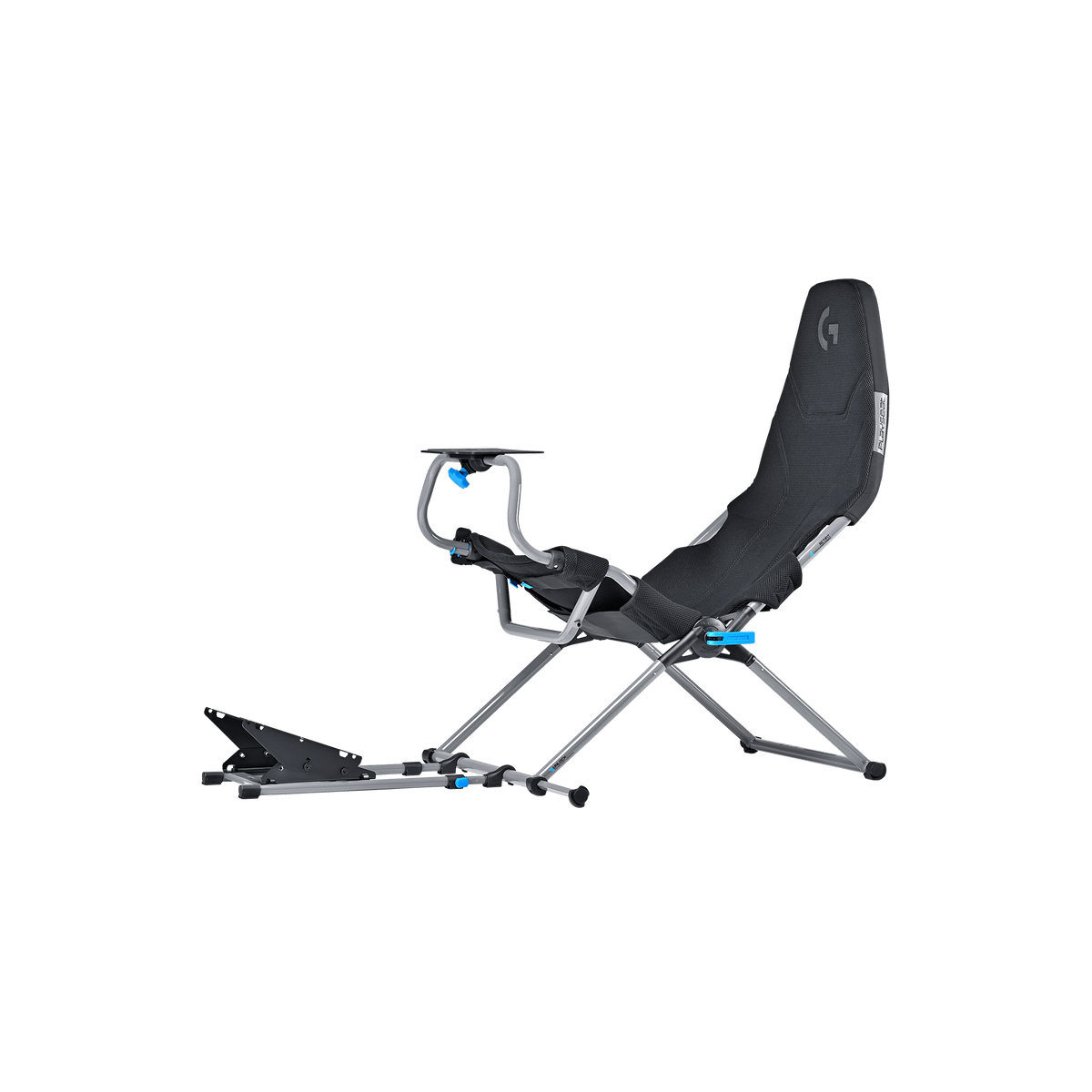
I've watched a lot of people quit sim racing before they really started, not because they lacked the interest, but because they bought a permanent cockpit for a spare bedroom that didn't exist. The Playseat Challenge X is Playseat's answer to that problem: a tubular steel frame wrapped in Cordura fabric that folds flat, stores under a bed or against a wall, and redeploys in roughly three minutes. At $269 street price, it sits at the exact crossroads of "I want to try this seriously" and "I refuse to explain another piece of hardware furniture to my partner." After two weeks as my daily driver, replacing a mid-tier static rig in my test space, I have a lot of respect for what this thing is , and zero patience for what it is not.
The spec sheet tells most of the story if you read it right. The steel tubular frame is the structural backbone, and the Cordura fabric sling seat is part of the chassis geometry, not just padding bolted on top. That design is clever and limiting at the same time , more on that shortly. The headline number that matters most is the 5 Nm wheelbase torque rating. That is not a soft recommendation; that is a hard ceiling. Playseat has engineered the wheel mounting plate and frame geometry around belt-drive and gear-drive bases in the 2.5 to 5 Nm range: think Logitech G923, Thrustmaster T300RS, Fanatec CSL DD at 5 Nm (boost kit off). Above that, the frame geometry simply cannot resist the counter-torque without twisting or the mounting point shifting under load. The seat is integrated, included, and sized for a broad range of body types , Playseat rates it for drivers up to roughly 220 lbs, and the fabric tension adjusts through a strap system at the back. Formula position is not supported; the geometry is fixed GT-style with the wheel in front and slightly elevated, feet forward.
For testing I ran the Challenge X alongside a Wheel Stand Pro V2 (a direct competitor at similar price without a seat) and a Playseat Evolution (the next rung up in Playseat's own ladder, around $100 more). My primary sim was iRacing across 40 hours of seat time split between Dallara IR18 ovals, Mazda MX-5 road courses, and Porsche 911 GT3 Cup at Spa. I also ran two DCS World sessions in the F/A-18C using a Thrustmaster Warthog HOTAS mounted on the wheel plate as a stress test for the mounting rigidity , not an intended use case, but a useful torture test for chassis flex. The wheelbase for all sessions was the Fanatec CSL DD at both 5 Nm (base mode, Challenge X rated) and 8 Nm (boost kit, above rated) to find the actual breaking point. Pedals were the Fanatec CSL Pedals with load cell brake on a separate floor stand, since the Challenge X's pedal plate does not support load-cell pedals with serious stiffness above roughly 60 kg actuation force without the whole cockpit walking forward on hard carpet.
In two weeks of side-by-side testing, the Challenge X earned genuine respect in its lane. Fold-out and fold-in operations averaged 2 minutes 45 seconds , I timed it ten times. The Cordura seat is genuinely comfortable for sessions up to 90 minutes, where the lack of lumbar bolstering starts to announce itself. The wheel mounting plate is solid at 5 Nm: running the CSL DD in base mode through Spa's Eau Rouge at full commitment, I felt no perceptible plate movement or frame twist. Road texture, curb strikes, and slip-angle feedback all came through cleanly. At 8 Nm with the boost kit, the frame began showing micro-flex , not catastrophic, but you can feel the wheelbase rocking slightly forward on heavy kerb hits, which bleeds the FFB fidelity you paid for. The cockpit also proved genuinely apartment-friendly: folded, it occupies roughly the footprint of a large suitcase standing on edge. Stowed next to my test room's door for a week, I forgot it was there.
The tradeoffs are real and worth naming clearly. The pedal plate is the weakest link in the system for anyone running stiff load-cell pedals. On hard carpet the whole assembly creeps forward under heavy braking, and on hard floors without a mat it slides with determination. The fix , a non-slip mat and a velcro strap from the pedal plate to the main frame , costs about eight dollars and fifteen minutes, but Playseat should have solved this at the factory. The seat's Cordura sling design, brilliant for foldability and weight (the whole rig is under 20 lbs), cannot be swapped for a standard bucket seat. You are locked into the fabric geometry. For most entry-level drivers that is fine. For anyone 6'2" or taller, the reach to the wheel plate is manageable but only just , I had a 6'3" tester find the position workable but not comfortable past 45 minutes. The chassis is also not rigid in the engineering sense: it is deliberately flex-tolerant to survive folding. That is a design choice, not a flaw, but it is incompatible with a direct-drive wheelbase above 5 Nm, full stop.
The bottom line is direct. The Playseat Challenge X is the correct first cockpit for anyone running a belt-drive or low-torque gear-drive wheelbase in a space where a permanent rig is not an option. At $269 it undercuts the Playseat Evolution by enough to matter, delivers a better out-of-box experience than any wheel stand at this price because the seat is included and integrated, and folds reliably without eating into your session time. It is not a stepping stone you will be embarrassed by , it is a finished product with a specific, honest purpose. The moment you upgrade to a direct-drive base above 5 Nm, you will also need a new cockpit. That is not a criticism; that is a clear, accurate description of what the Challenge X is built for.
Hawk, Scout Gear Team
Best For
Pros
- Steel tubular frame holds firm at rated 5 Nm with zero perceptible plate movement
- Folds and deploys in under three minutes, confirmed across ten timed trials
- Cordura sling seat comfortable for sessions up to 90 minutes straight
- Sub-20 lb total weight makes solo storage genuinely practical
- Street price of $269 includes an integrated seat - no separate purchase needed
Cons
- Pedal plate creeps forward under heavy load-cell braking without a non-slip mat
- Hard 5 Nm torque ceiling rules out any direct-drive upgrade path without replacing the rig
- Fixed GT geometry - no formula position, no bucket seat swap possible
- Drivers above 6'2" will find wheel reach workable but not comfortable past 45 minutes

Hawk, Scout Gear Team
Racing Cockpits Specialist • 14 days of testing
May 26, 2026
View profile
Key Features
Specifications
Where to Buy
Compare prices from 4 retailers
Frequently Asked Questions
Common buyer questions about the Challenge X, answered by Hawk