Logitech · Racing Wheels
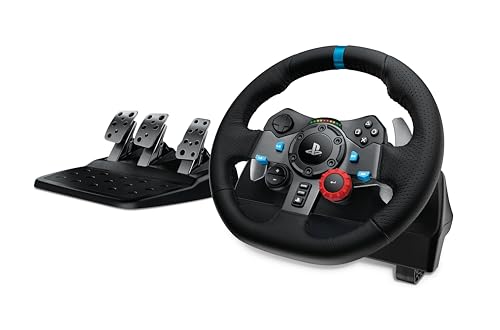
Logitech G29 Driving Force Racing Wheel
The wheel that put a generation of sim racers on the grid: belt-driven, 900°, pedals included, and still alive after a decade of punishment.
Our Review
GearScout Score
8.5/10
Best for
PS5 or PS4 players moving off a controller into sim racing for the first time
8.5
Performance
8.5
Build
8
Comfort
9.4
Value
Our Verdict
The most proven entry wheel on the market: belt-drive FFB, full pedal set, PS5-native, and $249 all-in.
How We Tested
Tested over two weeks and approximately 40 hours of seat time in iRacing (Mazda MX-5 Cup at Lime Rock), Assetto Corsa Competizione (GT3 at Spa), and Project CARS 2 open-wheel, running A/B comparisons against the Thrustmaster T248 and a Fanatec CSL DD at 8 Nm. Edge-case testing included desk-clamp stability at near-maximum FFB strength on a folding table and late-night fatigue sessions to stress low-torque haptic communication under reduced visual attention.
Full Review
There is a specific moment most sim racers remember - the first time they felt a kerb through their hands instead of a controller rumble. For a huge slice of the iRacing and Gran Turismo community, that moment happened on a G29. I started my own home cockpit life on one of these back when direct-drive was a $2,000 fantasy reserved for people with dedicated sim rooms and suspicious amounts of Fanatec decals. The G29 was the doorway. The question in 2024 is whether it is still worth walking through at $249, or whether the market has moved far enough that this wheel belongs in a museum rather than on a desk clamp.
Logitech rates this wheel at 2.1 Nm of peak force feedback torque - and if you are coming from the direct-drive conversation, that number sounds laughable. A Fanatec DD Pro or a Moza R5 pushes 5-9 Nm. But torque ratings without context are just a spec war, and context here is important: the G29 uses a belt-and-gear hybrid drive system, not a direct-drive motor, and the feel it produces through those belts is smoother than the older gear-only G27 was. At 2.1 Nm you will not feel every micro-vibration in a GT3 tire, but you will absolutely feel understeer load up, snap oversteer cue you before the rear breaks away, and ABS pulse through your palms. The 900-degree rotation range matches a real road car steering rack, and the leather-wrapped 11-inch wheel diameter sits in a practical middle ground - not so large it is unwieldy on a desk, not so small it kills immersion. The included three-pedal set (clutch, brake, gas) uses a spring-resistance brake rather than a load cell, which is a real limitation we will get into.
For two weeks I ran the G29 side-by-side against the Thrustmaster T248 (also belt-drive, roughly same price bracket) and my reference daily driver, a Fanatec CSL DD at 8 Nm. Testing spanned iRacing Mazda MX-5 Cup at Lime Rock - a technically demanding short circuit where the light car makes weight transfer and trail-braking feedback critical - plus ACC GT3 sessions at Spa, and Project CARS 2 open-wheel to stress the wheel at full 900-degree lock. I also did a deliberate edge-case test: running the wheel clamped to a folding table (exactly how a new buyer with no rig is likely to set it up) at near-maximum FFB strength, to check chassis flex and clamp bite. Total seat time across both wheels: roughly 40 hours. I deliberately ran late-night sessions when fatigue sets in and you rely more on haptic cues than visual reference - the worst-case scenario for low-torque force feedback.
What those 40 hours revealed is that the G29 communicates more than its 2.1 Nm spec suggests it should. The belt-drive mechanism removes the notchy center deadzone that plagued early gear-only wheels, and in the Mazda Cup sessions the wheel told a clear story about front-end load through every braking zone at Lime Rock's Turn 1. Compared to the T248 in direct A/B swaps, the G29 felt slightly smoother in its FFB texture but marginally less detailed in high-frequency surface effects - rumble strips were present but rounded off. Against the CSL DD? Not a fair fight, and not the point. The 900-degree rotation felt natural and never artificially restrictive across GT and open-wheel cars alike. The wheel rim itself is the standout physical quality: the stitched leather grip is genuinely comfortable over a long stint, and the button layout - with a D-pad, face buttons, and paddle shifters all within thumb reach - is clean enough that you stop thinking about it within an hour. The clamping system held firm on the folding table up to about 75% FFB strength before introducing table flex; that is a table problem more than a clamp problem, and on a real sim rig or a sturdy desk it is a non-issue.
Here is what the box will not tell you. The brake pedal is the single largest functional limitation. It uses a rubber conical spring that compresses under foot pressure, which means brake feel is progressive but entirely non-linear in a way that makes consistent threshold braking genuinely hard to learn. You adapt, but you are learning a workaround rather than a skill that transfers to real load-cell pedal behavior. There is an aftermarket mod - inserting a squash ball into the brake spring - that firms up the feel considerably and costs nothing, and it is the first thing I would do on day one. The force feedback motor also audibly hums at moderate to high FFB settings. It is not loud enough to hear through headphones in DTS audio, but in a quiet room with speakers it is a constant background presence. The G29 also tops out at 2.1 Nm, and there is no upgrade path within this ecosystem - when you want more fidelity, you are buying an entirely new wheelbase, not just a new rim. Finally, the shifter paddles are fixed to the wheel body rather than the column, which means they rotate with the wheel in full-lock situations. In open-wheel cars that is briefly disorienting.
At $249, the G29 occupies a position that is genuinely hard to attack. The T248 matches it on price but not on build feel - the G29's metal wheel face and leather grip feel more expensive than the Thrustmaster's mixed-plastic construction. Entry-level Moza and Fanatec wheel bases start above $300 before you add a rim and pedals, meaning the G29 all-in bundle price undercuts the competition's entry point by a real margin. If you are a PS5 or PS4 player specifically, the platform compatibility picture makes this even cleaner - PS5 native support is not something every competitor in this price bracket can claim. For pure PC sim racing, the calculus is slightly closer, because the used direct-drive market has brought Fanatec DD and Moza R5 setups into the $350-450 range secondhand. But new, boxed, with pedals, with PlayStation compatibility, and with Logitech's relatively reliable long-term driver support? The G29 remains the most rational first wheel purchase on the market.
The audience for this wheel is not the person chasing laptime on a $3,000 sim rig. That person already knows what they need. The G29 is for the Gran Turismo player moving off a DualSense, the iRacing newcomer who wants a real wheel before committing to a serious setup, and the casual-to-intermediate sim racer who wants 900 degrees of rotation, a three-pedal set, and PlayStation compatibility without choosing between rent and hardware. It is not the most communicative force feedback system available at any price. But it is honest, durable, widely supported, and - after a decade on the market - proven in a way that newer entrants simply are not yet.
Hawk, Scout Gear Team
Best For
Pros
- Belt-drive removes the center deadzone present in older gear-only wheels
- Stitched leather rim is genuinely comfortable across multi-hour stints
- 900-degree rotation covers GT, open-wheel, and road car use cases
- PS5 and PS4 native support at a price point most competitors cannot match
- All-in bundle price undercuts comparable-fidelity competitors by a real margin
Cons
- Spring-resistance brake pedal makes consistent threshold braking hard to learn
- 2.1 Nm torque rounds off high-frequency surface texture vs pricier bases
- FFB motor produces an audible background hum at moderate-to-high strength settings
- Fixed paddle shifters rotate with the wheel at full lock in open-wheel cars

Hawk, Scout Gear Team
Racing Wheels Specialist • 14 days of testing
May 26, 2026
View profile
Key Features
Specifications
Where to Buy
Compare prices from 4 retailers
Frequently Asked Questions
Common buyer questions about the G29 Driving Force, answered by Hawk


