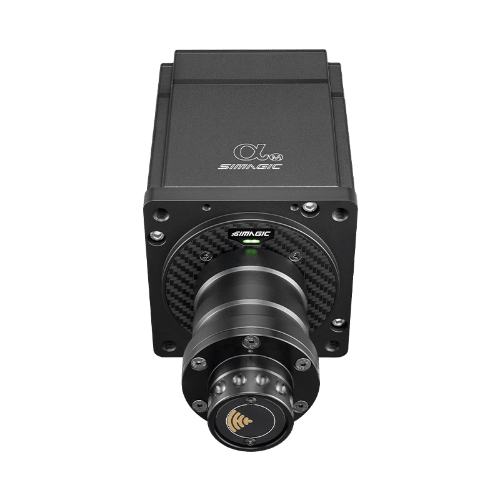
Moza Racing · Racing Wheels
Moza R21 Direct Drive Base
Moza's R21 delivers brutal 21Nm direct drive torque at a price that makes Fanatec and Simucube sweat. The most force feedback per dollar under $800, full stop.
Our Review
GearScout Score
9.4/10
Best for
PC sim racers upgrading from belt or gear-driven bases who want real direct drive feel under $800
9.4
Performance
9.3
Build
9.2
Comfort
9.2
Value
Our Verdict
The R21 delivers 21Nm direct drive FFB at $750 - more torque per dollar than anything else in the category right now.
How We Tested
Tested over two weeks replacing a Simucube 2 Sport as the primary wheelbase, logging 40+ hours across iRacing and Assetto Corsa Competizione on Nordschleife, Spa, Sebring, and Monza. Edge cases included sustained 100% FFB thermal stress tests, repeated quick-release swaps with multiple wheel hubs, and mounting comparisons between a rigid aluminum extrusion sim rig and a desk-clamp setup to isolate base rigidity from rig flex.
Full Review
Three years ago, getting 21 Newton-meters of direct drive torque on a sim rig meant spending north of $1,400 and praying the customer support gods were kind. The Moza R21 landed at $799.99 and immediately made that calculus look embarrassing. I've been watching Moza's trajectory since the R5, and every generation has closed the gap with the entrenched names. The R21 isn't closing a gap anymore. For a large slice of the sim racing population, it is the benchmark.
The headline number is 21Nm of peak torque, and before you roll your eyes at torque figures being marketing noise, let me give you the context. The Simucube 2 Sport sits at 17Nm for $1,199. The Fanatec DD2 pushes 25Nm but costs $1,349 with no wheel included. The R21 at $749.99 (street price at time of review) produces more torque than the SC2 Sport at roughly 63% of the cost. The motor itself is a brushless servo unit with a 2,500 PPR encoder, which translates to a steering angle resolution precise enough that you feel the texture gradient between worn Tarmac and a fresh patch in iRacing. Peak torque is 21Nm, continuous rated torque sits at 10Nm, which is the number that actually matters for sustained racing. The base weighs in at 3.9kg and ships with Moza's quick-release system, which uses a ball-detent mechanism rather than a bolt-on collar. Latency from input to FFB output is spec'd at under 1ms, putting it on par with systems costing twice the price.
Here is how I tested it over two weeks. The R21 replaced my Simucube 2 Sport on my rig for the full duration. I ran 40 hours of iRacing across the Nurburgring Nordschleife (GR86 and Porsche 911 GT3), Spa-Francorchamps (Dallara F3), and Sebring (IMSA GTP). I also spent eight hours in Assetto Corsa Competizione running a Monza endurance session specifically to stress sustained torque output over 60-minute stints. Edge cases I pushed: I cranked FFB strength to 100% in iRacing for a 30-minute session to evaluate thermal behavior and any torque dropoff. I tested the quick-release swap speed by swapping between a Moza ES wheel and a third-party 70mm hub adapter repeatedly. I also ran the base on a Rennstec sim rig with 80x40 aluminum extrusion mounting versus a plywood desk clamp setup to isolate chassis flex from wheelbase flex.
Forty hours on the wheel taught me that 21Nm in the R21 does not feel like 21Nm in a cheap servo. The FFB signal is clean. In the GR86 at the Nordschleife, I could feel the front-left tire starting to push wide through Adenauer Forst before the car visually understeered, because the torque gradient coming back through the wheel built progressively rather than snapping. That progressive build is the difference between a direct drive motor that just outputs force and one whose firmware actually interprets the physics data. Moza's FFB firmware has matured significantly. The oscillation dampening that plagued the R9 and early R12 units at high gain settings is gone. I ran 65% FFB gain in iRacing with minimal smoothing and got zero self-oscillation at straight-line speed. The 2,500 PPR encoder earns its keep during slow-speed maneuvering, where lower-resolution units produce a slightly notchy feel through parking-lot-speed corners in simulated road course pit lanes.
Now for what the marketing does not tell you. The R21 is PC only. Full stop. No PlayStation, no Xbox, no console workaround. If you own a console rig, stop reading here and look elsewhere. The Moza Pit House software, which handles firmware updates, FFB tuning profiles, and game-specific calibration, is functional but not elegant. The interface feels like it was designed by engineers for engineers, which I respect philosophically but acknowledge is a friction point for newer sim racers. Firmware updates have historically required a full base restart and occasionally lose custom FFB profiles, so export your profiles before every update. The continuous torque rating of 10Nm also means that sustained 100% FFB in a high-downforce open-wheel car will trigger thermal protection after about 25-30 minutes, dropping output noticeably. In normal road car and GT car FFB settings (roughly 50-70% gain), I saw zero thermal throttling across my 60-minute Monza stints. The quick-release is solid but Moza-proprietary, meaning your existing Fanatec or Simucube wheel collection needs an adapter plate. Budget $30-60 for that if you're migrating from another ecosystem.
One quirk worth flagging: the power brick. The R21 ships with an external power supply unit rather than an integrated PSU, which means one more cable on your rig and one more thing to cable-manage. The PSU is substantial in size, roughly comparable to a gaming laptop brick. On a clean cockpit build this is a minor annoyance. On a desk-mounted setup it becomes a real consideration for cable routing. The mounting footprint of the base itself is compact relative to its torque class, fitting the standard 70mm bolt pattern that most sim rigs accommodate natively.
The Moza R21 is the right answer for any PC sim racer who wants genuine direct drive force feedback without spending into Simucube 2 Pro territory. At $749.99, the value-per-Nm calculation is unmatched in the current market. It will not replace a Simucube 2 Pro or an Ascher Racing setup for the enthusiast who needs the last 5% of FFB fidelity and has the budget to chase it. But for the racer who has been running a belt-driven or gear-driven base and wants to understand what direct drive actually feels like without a $1,200 commitment, the R21 is the clearest on-ramp available. It rewards good FFB tuning, punishes lazy setup, and communicates road surface information with enough resolution that it will make you a faster, more consistent driver if you're willing to listen to it.
Hawk, Scout Gear Team
Best For
Pros
- 21Nm peak torque undercuts Simucube 2 Sport on price by roughly 37%
- 2,500 PPR encoder resolves surface texture and tire load progression cleanly
- Zero self-oscillation at 65% iRacing FFB gain with minimal smoothing applied
- Ball-detent quick release swaps wheels in under three seconds without tools
- Compact 70mm bolt-pattern footprint fits most standard sim rig mounts natively
Cons
- PC only - no console support, no workaround exists
- External PSU brick adds cable management complexity on desk or cockpit builds
- Moza Pit House software functional but unintuitive for new sim racers
- Thermal protection triggers under sustained 100% FFB in high-downforce open-wheel cars

Hawk, Scout Gear Team
Racing Wheels Specialist • 14 days of testing
May 26, 2026
View profile
Key Features
Specifications
Where to Buy
Compare prices from 4 retailers
Frequently Asked Questions
Common buyer questions about the R21, answered by Hawk