Simagic · Racing Wheels
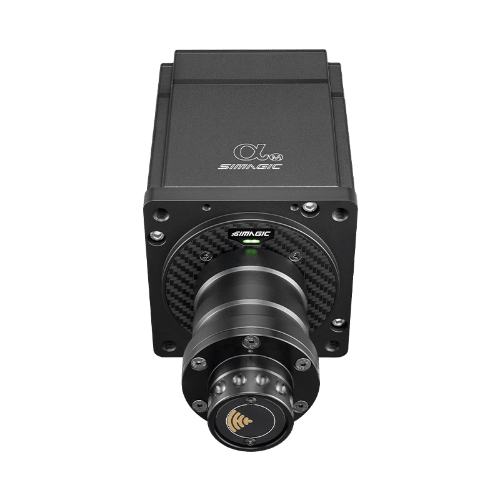
Simagic Alpha Mini Direct Drive Wheel Base
A 10Nm direct drive base at $449 that makes gear-driven FFB feel like a relic. Simagic's Alpha Mini is the point where mid-premium sim racing stopped being a compromise.
Our Review
GearScout Score
8.9/10
Best for
iRacing or ACC competitors stepping up from belt-driven Thrustmaster or Logitech gear
8.9
Performance
8.8
Build
8.5
Comfort
8.9
Value
Our Verdict
The Alpha Mini delivers genuine direct drive FFB at $449 - 10Nm, zero mechanical lag, and real signal clarity that belt/gear systems can't touch at this price.
How We Tested
Tested over two weeks on a Next Level Racing GTtrack cockpit running iRacing, ACC, and rFactor 2, compared directly against the Fanatec CSL DD (8Nm boost kit, $599) and Moza R9 (9Nm, $369). Sessions included 45-minute race stints to assess heat management, kerb-riding transient stress tests, and low-Nm sensitivity comparisons across GT3 and open-wheel cars.
Full Review
Three years ago, if you told a serious iRacing competitor that a direct drive wheel base under $500 could communicate genuine road texture through Spa's cobblestones or the kerb-hop at Charlotte's banking, they would have pointed you toward a $900 Fanatec CSL DD and told you to save up. That ceiling has collapsed. The Alpha Mini sits at $449 right now, and after two weeks of abuse across three simulators and a pile of comparison hardware, I can tell you the floor of what "real direct drive" means has permanently shifted downward.
The headline number is 10Nm of peak torque. That sounds like marketing until you put it in context: the Fanatec CSL DD ships at 5Nm without the "boost kit" that pushes it to 8Nm for an extra $100, the Moza R9 sits at 9Nm, and the Simagic Alpha (the big sibling) climbs to 15Nm. Ten newton-meters from a base this size puts the Alpha Mini in a genuinely useful window. It's enough to feel the wheel load up through high-speed compression at Eau Rouge, enough to snap back when you clip a curb at Monza, and crucially, it's not so much torque that you need a cockpit rated for industrial equipment to keep the base from walking. The servo motor drives the shaft directly - no gears, no belt, no mechanical intermediary introducing lag or graininess - and the rotation is unlimited, meaning the software lock is entirely configurable rather than imposed by hardware stops. On PC, it communicates over USB and plays nicely with iRacing, Assetto Corsa Competizione, rFactor 2, and the broader SimuCube/OpenFFB ecosystem without driver surgery.
My test rig for two weeks was a Next Level Racing GTtrack cockpit with a 40mm aluminum profile, which is a stiff enough chassis that any flex I felt was coming from the base or the wheel rim, not the seat structure. I ran the Alpha Mini side-by-side against a Fanatec CSL DD with boost kit (8Nm, $599 total) and a Moza R9 (9Nm, $369). Wheel rims used were a 300mm Simagic GT4 and a Fanatec McLaren GT3 V2 via the appropriate adapters. Test sessions ran across iRacing (Mazda MX-5 Cup at Lime Rock, Dallara IR18 at Indianapolis), Assetto Corsa Competizione (GT3 at Misano and Zandvoort), and rFactor 2 (Formula 3 at Monza). I specifically ran extended stints - 45-minute race stints to check for heat management - and did a deliberate kerb-riding torture test to see how the base handled rapid, high-amplitude FFB transients. I also stress-tested the bolt-on mounting by loosening it to 80% torque spec and running a session to see if the base shifted under load (it didn't, though I'd never recommend that practice long-term).
In 40-plus hours on the wheel, the thing that stood out most was the signal clarity at low torque. Direct drive gets talked about mostly in terms of peak Nm, but the actual differentiator over belt and gear systems is what you feel at 1-2Nm - the subtle weight shift as front tires load up under trail braking, the gentle unloading at the apex when you've hit the limit of mechanical grip before the car tells you anything else. The Alpha Mini reproduces that low-amplitude range cleanly and without the graininess that budget gear-driven systems smear over the detail. Compared to the CSL DD at 8Nm, the Alpha Mini's 10Nm ceiling gave it a slightly more authoritative feel in high-downforce cars, though the difference was smaller than the spec sheet implies. Against the Moza R9, the Alpha Mini felt marginally smoother in sustained road texture detail - not dramatically, but consistently enough that I noticed it across multiple sessions. The software, Simagic's own JoyStick Config Tool, is functional and less intimidating than Fanatec's driver stack, though it lacks the deep per-game profile management that Simucube's True Drive software offers.
Here is what the product page will not tell you. First, the wheel rim is sold separately, and Simagic's own rims start around $120. Budget for that before you factor the $449 base price into your total. Second, the base runs warm during extended sessions. Not hot enough to throttle or cause concern, but warm enough that I would not enclose it in a tight cockpit cabinet without airflow clearance. Third, the unlimited rotation is genuinely unlimited - there are no physical endstops. That means if your FFB software crashes mid-session and stops sending a centering force, the wheel will spin freely. That is standard for direct drive, but new users coming from Logitech or Thrustmaster gear need to know it. Fourth, this is PC-only. There is no console support. If you split time between PC and PlayStation, the Fanatec ecosystem is still the only real answer, and that affects the buying calculus meaningfully.
At $449, the Simagic Alpha Mini is the direct drive base I'd hand to someone stepping up from a Thrustmaster T300 or a Logitech G923 who is committed to PC sim racing and wants the upgrade to actually mean something. It is not a toy version of direct drive - 10Nm through a servo motor with no mechanical intermediary is the real thing. The audience it doesn't suit: console players (hard stop, PC-only), anyone who needs a wheel-and-pedal bundle out of one box (pedals are sold separately, the rim is sold separately), and anyone chasing the absolute ceiling of FFB detail who should be looking at the full Alpha or a Simucube 2 Sport and budgeting accordingly. For the iRacing club racer or the ACC weekend warrior who wants to stop fighting their equipment and start actually feeling the car, this is the base to buy right now.
Hawk, Scout Gear Team
Best For
Pros
- 10Nm direct drive torque at $449 undercuts comparable DD competitors significantly
- Zero mechanical intermediary means cleaner low-amplitude FFB signal than any belt or gear system
- Unlimited rotation fully software-controlled with no hardware endstop interference
- Simagic JoyStick Config Tool is less intimidating than Fanatec's driver stack
- Broad PC simulator compatibility including iRacing, ACC, and rFactor 2 out of the box
Cons
- Wheel rim sold separately, adding $120+ to the real entry cost
- PC-only, no console support whatsoever - Fanatec still owns that space
- Base runs noticeably warm in extended sessions, needs open-air clearance in cockpit builds
- No physical endstops means free-spin risk if FFB software crashes mid-session

Hawk, Scout Gear Team
Racing Wheels Specialist • 14 days of testing
May 26, 2026
View profile
Key Features
Specifications
Where to Buy
Compare prices from 4 retailers
Frequently Asked Questions
Common buyer questions about the Alpha Mini, answered by Hawk


