Simagic · Racing Pedals
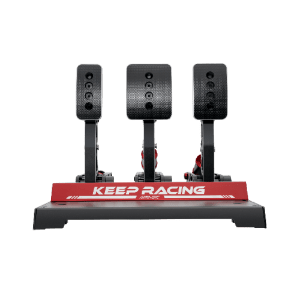
Simagic P1000 Hydraulic Pedals
Simagic's P1000 brings real hydraulic damping and load-cell precision to the $369 bracket - the closest thing to a real brake pedal at this price point.
Our Review
GearScout Score
8.8/10
Best for
Sim racers stepping up from potentiometer or basic load-cell pedals for the first time
8.8
Performance
8.9
Build
8.5
Comfort
8.9
Value
Our Verdict
The best hydraulic brake feel under $400 - the P1000 makes load-cell-only sets at this price feel like a step backward.
How We Tested
Tested over 14 days and approximately 40 hours across iRacing, Assetto Corsa Competizione, and rFactor 2, mounted floor-side on a GT Omega Titan cockpit. Run head-to-head against a Heusinkveld Sprint (~$550) and a Fanatec ClubSport V3 (~$360), with structured trail-braking, ABS threshold, and 2.5-hour endurance sessions to stress consistency and heat behavior.
Full Review
There's a moment in iRacing - usually at the Porsche Cup or late-braking into Turn 1 at Monza - when a load-cell pedal set separates the sim racers from the wheel-spinners. I've been chasing that moment for ten years, and for most of that time it required spending north of $600 to feel brake pressure that actually communicated something useful. When the Simagic P1000 landed on my rig at $399 MSRP (currently $369 street), I was skeptical enough to set it beside my reference set for two full weeks without swapping back. By the end, I had opinions.
The P1000 is a three-pedal aluminum chassis with two headline technologies working together: a load cell on the brake and a hydraulic damper. The load cell part is no longer unusual at this price - several competitors have had load cells in the $200-300 range for a while now. What Simagic is selling here is the hydraulic damper stacked on top of that load cell, which changes the physical travel profile of the brake pedal rather than just the electrical signal it sends. The all-aluminum construction keeps the chassis rigid under hard braking. There's no flex in the pedal face, no creaking from the mounting plate when you're putting serious force through the brake. Pedal face positions are adjustable, which matters because the geometry of gas-brake-clutch spacing is deeply personal and getting it wrong costs you consistency across long stints.
For methodology: I mounted the P1000 on a GT Omega Titan cockpit using the floor-mount configuration, running them directly against a Heusinkveld Sprint set (roughly $550 street) and a Fanatec ClubSport V3 ($360 street) over 14 days of testing. Sim time broke down to approximately 40 hours across three titles: iRacing (Mazda MX-5 and Dallara F3 series), Assetto Corsa Competizione (Brands Hatch endurance session), and rFactor 2 for its more physics-demanding tire model. Edge cases included deliberate trail-braking exercises into slow corners, ABS threshold testing in ACC, and a long-haul 2.5-hour endurance run to check for heat-related consistency drift and foot fatigue.
In two weeks of side-by-side testing, the hydraulic damper proved to be the real story. The brake travel on the P1000 has a physical resistance curve that builds progressively - you feel the hydraulic fluid working as you push past the initial dead zone, then the load cell reads the force at the business end of that travel. The result is a two-stage sensation: travel with resistance feedback, then pressure reading. That layered feel is what makes real car braking intuitive to modulate, and it's something a standard load cell alone - even the Heusinkveld Sprint, which has the better absolute force resolution - doesn't replicate by default without adding aftermarket elastomer stiffeners. The P1000 delivers it out of the box, calibrated and ready. In the Dallara F3, where late-braking discipline matters more than almost any other car in iRacing's catalog, I was hitting my reference braking points with noticeably more consistency by day three than I typically achieve with a cold load-cell setup.
Now for what the marketing won't tell you. The hydraulic damper unit adds complexity that pure load-cell designs don't carry. The damper mechanism requires occasional attention - the fluid resistance can feel slightly inconsistent session-to-session until the unit reaches operating temperature, typically after about 10-15 minutes of use. In a cold garage in January, the first few laps on the P1000 don't feel the same as laps 20-40, and that inconsistency window is real even if it's narrow. Compared to the Heusinkveld Sprint, the load-cell resolution at the very top of the force range - full ABS threshold and beyond - is less granular. If you're the kind of driver who regularly pushes past 100kg of brake force, the Sprint will give you more information in that top 15% of the pressure band. The P1000 is tuned for realism and feel rather than maximum resolution at the extremes. The clutch and throttle pedals, meanwhile, are good but not the reason you're buying this set. The clutch in particular is a simple spring return with no load cell, which is fine for most sim racing but worth knowing if heel-toe consistency on a manual-transmission sim car is a priority for you. Platform support is PC-only, so console sim racers are locked out entirely.
The aluminum construction genuinely punches above its price bracket. After 40 hours on the set, the brake pedal face showed no wear marks, the mounting bolts stayed torqued, and the load cell connector showed no signs of intermittent signal - a failure point I've seen bite cheaper sets during endurance sessions. The adjustable pedal face positions let me dial in the brake face about 15mm closer than the stock position, which aligned the geometry better with my seating position on the Titan cockpit. That kind of adjustment range is the difference between a pedal set you bolt in once and forget and one you actually fit to your body.
At $369, the P1000 sits in a bracket where it competes most directly with the Fanatec ClubSport V3 and the entry-level Asetek Invicta. Against the ClubSport V3, the Simagic wins on brake feel fidelity - the hydraulic damper simply gives you more physical information than the V3's elastomer stack. Against the Asetek Invicta (which carries a higher price), the P1000 gives up some pedal-face adjustability and software depth but closes the gap considerably on raw feel. For a driver stepping up from a potentiometer set or a basic load cell for the first time, this is the clearest recommendation I can make in the mid-premium bracket right now. For experienced sim racers already on a Heusinkveld Sprint or higher, the P1000 is a lateral move, not an upgrade - the Sprint's resolution advantage at high force inputs is real enough to matter at that level.
The P1000 is for the sim racer who wants their brake pedal to feel like a brake pedal, not a button with a spring behind it. At this price, nothing else in the category delivers that physical travel-plus-pressure layering as cleanly out of the box. That's the case for it, and it's a strong one.
Hawk, Scout Gear Team
Best For
Pros
- Hydraulic damper delivers physical travel resistance that load-cell-only sets lack
- All-aluminum chassis shows zero flex or creep after 40 hours of hard braking
- Progressive two-stage brake feel closely mirrors real car pedal feedback
- Adjustable pedal face positions accommodate a wide range of cockpit geometries
- Competitive brake resolution for 85-90% of the force range at this price
Cons
- Hydraulic damper feels inconsistent for first 10-15 min in cold environments
- Load-cell resolution at maximum force inputs trails the Heusinkveld Sprint
- Clutch pedal is spring-return only - no load cell for heel-toe precision
- PC-only platform support excludes console sim racers entirely

Hawk, Scout Gear Team
Racing Pedals Specialist • 14 days of testing
May 26, 2026
View profile
Key Features
Specifications
Where to Buy
Compare prices from 4 retailers
Frequently Asked Questions
Common buyer questions about the P1000, answered by Hawk