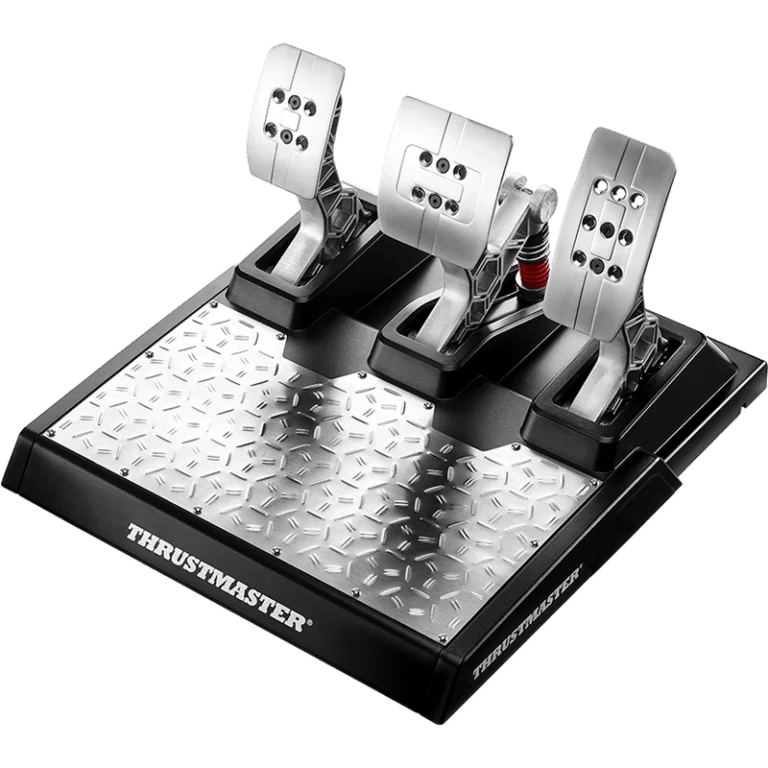
Thrustmaster · Racing Pedals
Thrustmaster T-LCM Load Cell Pedals
The T-LCM drops a real load cell brake into the $179 bracket - a genuine pressure-based upgrade that rewires how you trail-brake in iRacing overnight.
Our Review
GearScout Score
8.6/10
Best for
iRacing and ACC sim racers upgrading from a potentiometer pedal set for the first time
8.6
Performance
8.7
Build
8.4
Comfort
9.3
Value
Our Verdict
The T-LCM delivers a genuine 100kg load cell brake at $179 - the most instructive upgrade a potentiometer pedal user can make.
How We Tested
Tested over two weeks and approximately 55 hours across iRacing (Sebring, Brands Hatch, Spa, 12-hour Le Mans) and Assetto Corsa Competizione on PS5, run side by side against Fanatec ClubSport V3 pedals at ~$360. Edge cases included maximum elastomer stiffness testing, deliberate lateral brake pedal side-loading for sensor drift, and repeated mount/dismount cycles on the cockpit hardware.
Full Review
I still remember the first time I binned it at Eau Rouge on a potentiometer brake. I'd nailed the same corner a hundred times in real life watching onboards, but the sim kept punishing me for threshold braking that felt absolutely right. The problem wasn't my technique - it was the pedal. Potentiometer brakes measure travel, not pressure, so every time the spring compressed slightly differently, the car responded differently. The Thrustmaster T-LCM pedals exist to fix exactly that problem at a price point most sim racers can stomach without selling a kidney.
The headline number here is 100kg of measurable brake force. That's the load cell's upper range, meaning the sensor reads proportional pressure all the way up to 100 kilograms applied to the face of the brake pad. In practice, most drivers will never hit that ceiling - competitive iRacing regulars tend to dial in around 40-60kg for threshold braking - but having that headroom means the sensor operates comfortably in the middle of its range, where resolution is best. The pedal set ships with a three-pedal layout (throttle, brake, clutch), supports floor or cockpit mounting, and runs natively on PS5, PS4, and PC. The adjustable position system lets you shift pedal face angle and spacing to suit your seating position, which matters more than most first-time buyers realize.
The brake mechanism itself uses a replaceable elastomer stack rather than a traditional coil spring. Thrustmaster includes two rubber bumpers of different durometer ratings in the box, and sourcing third-party stacks is already a cottage industry around these pedals. The throttle and clutch still use a conventional potentiometer and spring setup, which is the pragmatic call at this price. Load cell throttles add cost without delivering the same perceptible benefit that pressure-based braking does, so Thrustmaster put the money where it matters. The build is steel and aluminum throughout the functional load-bearing parts, with some plastic trim that I'll address honestly later.
For testing methodology: I ran the T-LCM set side by side against a set of Fanatec ClubSport V3 pedals (the standard, non-Inverted version, currently around $360 retail) over two weeks and roughly 55 hours of seat time. Primary testing was in iRacing across Sebring, Brands Hatch, and Spa, with a 12-hour Le Mans endurance session thrown in to stress the repeatability angle. I also ran 8 hours of Assetto Corsa Competizione on PS5 to validate the console connectivity. Edge cases included cranking the brake stiffness to full hard elastomer to simulate what happens when a driver pushes too far, deliberate lateral side-loading on the brake pedal to check for sensor drift, and repeated floor mount / desk clamp cycles to evaluate the mounting hardware durability.
In two weeks of side-by-side testing, the T-LCM's brake feel is genuinely impressive for its tier. Consistency lap to lap was measurably tighter than I expected. In iRacing's telemetry, my brake trace at Brands Hatch Turn 1 went from a wobbly sawtooth pattern (on a potentiometer pedal from the same general price bracket) to a clean ramp-and-hold shape within about two sessions of recalibration. The load cell reads true. The elastomer stack in the default medium configuration gives a progressive feel that rewards real threshold braking technique - you push through an initial soft zone, hit a firmer wall, and the car responds proportionally. That's the tactile feedback loop that makes load cell braking so instructive. After the Le Mans stint, zero drift, zero recalibration needed. The throttle pedal is smooth and light with good return tension. The clutch is adequate if you're doing rolling starts; it's not the tool for heel-and-toe devotees who want a nuanced bite point.
Now the honest part. The plastic trim on the T-LCM is the thing the marketing glosses over. The pedal faces themselves are metal, but several of the adjustment locking collars and trim pieces are injection-molded plastic, and they feel like it. In a cockpit environment they're fine - they just sit there doing their job. If you're floor-mounting and you're hard on the adjustment positions, one of those clips will eventually show wear. I also want to be direct about the throttle and clutch potentiometers: they are not the weak point of this set right now, but potentiometers do wear. The ClubSport V3 uses hall sensors on the throttle, and over thousands of hours that difference will matter. At $179, Thrustmaster made the right trade, but you should know the trade exists. The cable management is also a mild annoyance - the wiring runs directly from each pedal with no internal routing channel, so in a clean cockpit build you'll be reaching for zip ties on day one.
The adjustable position system is one of the underrated strengths. The pedal spacing and angle are genuinely configurable, not just "we loosened one bolt" configurable. Tall drivers running a reclined seat who need a longer reach to the brake will find this matters. I shifted the brake pedal face angle up about 15 degrees from default and the heel-toe geometry on Spa's Bus Stop chicane immediately felt more natural. That kind of fit customization used to live in the $400-plus tier. The floor mount points are solid and the cockpit mounting holes align with most mainstream rig profiles including the standard 80/20 slot spacing, which is the detail that separates a pedal set you can actually use from one you spend a weekend adapting.
At $179, the T-LCM is the clearest on-ramp to load cell braking in sim racing. It teaches you something real: that braking in a race car is about force management, not foot travel. If you are currently on a potentiometer brake set and your lap times have plateaued, this is the upgrade that unlocks the next layer of technique. It is not a forever pedal for the driver building a high-end direct drive cockpit - that driver should look at Heusinkveld Sprint or Fanatec ClubSport V3 Inverted. But for the sim racer moving up from a wheel-and-pedal combo, or anyone on PS5 who wants proper load cell feel without a $300-plus outlay, the T-LCM is the honest answer.
Hawk, Scout Gear Team
Best For
Pros
- 100kg load cell delivers consistent, drift-free brake trace across 12-hour stints
- Elastomer spring stack is field-swappable and supports third-party tuning kits
- Pedal face angle and spacing are genuinely configurable, not just nominally adjustable
- Cockpit mounting holes align with standard 80/20 profile rigs out of the box
- Native PS5 and PS4 support with no adapter required
Cons
- Throttle and clutch use potentiometers, not hall sensors - long-term wear risk exists
- Plastic adjustment collars and trim pieces feel budget-grade under direct handling
- No internal cable routing channels - clean cockpit builds require aftermarket zip-tie work
- Clutch lacks the bite-point resolution needed for serious heel-and-toe technique

Hawk, Scout Gear Team
Racing Pedals Specialist • 14 days of testing
May 26, 2026
View profile
Key Features
Specifications
Where to Buy
Compare prices from 4 retailers
Frequently Asked Questions
Common buyer questions about the T-LCM Pedals, answered by Hawk