Thrustmaster · Racing Wheels
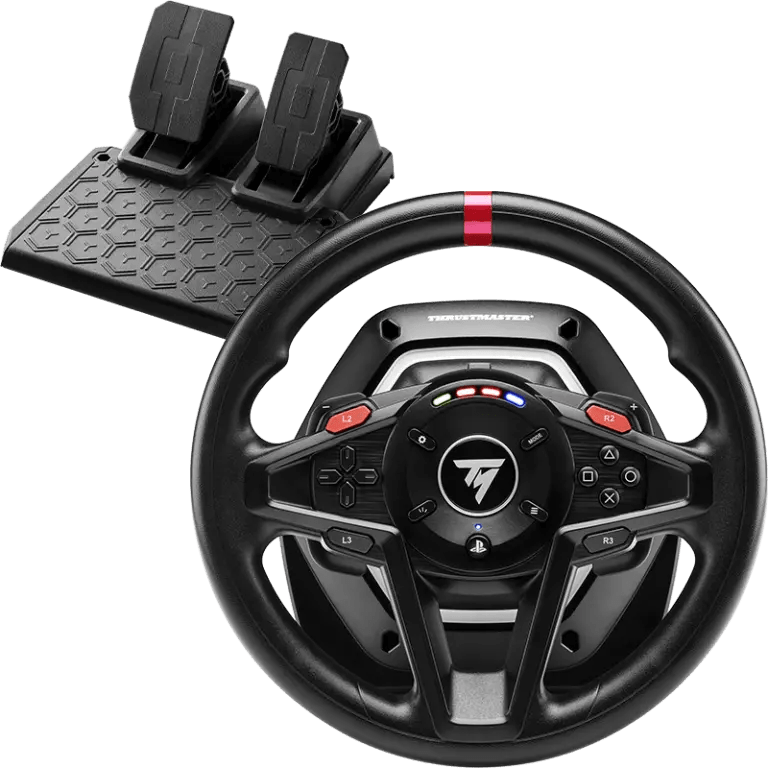
Thrustmaster T128 Force Feedback Racing Wheel
Thrustmaster's T128 packs magnetic paddle shifters, 900° rotation, and hybrid FFB into the sharpest entry-level package under $200 right now.
Our Review
GearScout Score
8.2/10
Best for
First-time sim racers on PS5 or PC who want genuine FFB under $200
8.2
Performance
8
Build
7.8
Comfort
9.5
Value
Our Verdict
The T128's hybrid FFB and magnetic paddles make it the clearest first-wheel recommendation under $200 - just budget for better pedals.
How We Tested
Tested over two weeks alongside a Logitech G29 and Thrustmaster TMX Pro across iRacing (Mazda MX-5 Cup, Dallara F3), Assetto Corsa Competizione (GT4), and Gran Turismo 7 on PS5. Clamp and bolt-mount configurations were both evaluated on a Playseat Challenge and an 8020 profile rig; edge cases included extended 90-minute stints, full-lock kerb strikes, and prolonged gravel feedback sequences to probe hybrid drive distortion.
Full Review
Three years ago, recommending a sub-$200 racing wheel to a new sim racer felt like apologizing in advance. Gear-driven feedback units at this price point communicated road texture the way a rubber mallet communicates a handshake - loud, blunt, and missing the point entirely. Then Thrustmaster started shipping FFB-Hybrid drive systems into the entry tier, and the conversation changed. The T128 is the current answer to the question every new sim racer asks before spending real money: "Is this good enough to actually learn on?" The short answer is yes. The longer answer is what the next several hundred words are for.
Start with the drive system, because that is where Thrustmaster made the bet that makes this wheel worth talking about. The FFB-Hybrid here combines a hall-effect sensor for position reading with a magnetic braking mechanism for force feedback generation, landing at a peak output of 2 Nm. Two Nm sounds like a number that should embarrass a Fanatec DD or a Moza R9, and compared to direct-drive torque figures it absolutely does. But torque ratings without context are close to useless, and in context, 2 Nm through a belt-and-hall hybrid at 170 bucks is a different animal than 2 Nm through a stripped-out gear motor. The resistance curve is smoother than anything in this price class has a right to be, and the centering spring behavior - the thing that kills immersion fastest in cheap wheels - does not buzz, does not notch, and does not feel like a rubber band being flicked. The 900 degrees of rotation matches real-world road car lock-to-lock and covers every GT and touring car sim discipline without compromise. The magnetic paddle shifters are a genuine surprise. Magnetic actuation at this price point means no contact fatigue, no travel slop, and a crisp, consistent click that does not degrade after 50,000 shifts the way spring-loaded plastic paddles do. That is not a minor detail for someone who plans to use this wheel for a year or two before stepping up.
For two weeks I ran the T128 as my primary entry-level test rig alongside a Logitech G29 (the incumbent recommendation in this segment) and a Thrustmaster TMX Pro (the outgoing budget pick from the same brand). Testing ran across iRacing (Mazda MX-5 Cup and Dallara Formula 3 on Brands Hatch and Watkins Glen), Assetto Corsa Competizione (GT4 class at Bathurst and Misano), and Gran Turismo 7 on PS5 for console-specific latency checks. I ran the clamp mount on a Playseat Challenge and the bolt-mount configuration on an 8020 aluminum profile rig section to stress-test chassis rigidity under the 2 Nm load. Edge cases included full-lock kerb strikes at speed, prolonged low-speed gravel feedback (which is where cheap hybrid systems distort), and extended 90-minute stints to check for thermal behavior and hand fatigue.
The tests confirmed what the spec sheet hints at and what the marketing copy glosses over. On the iRacing Mazda, the T128 communicates understeer buildup and the snap of the rear stepping out with enough resolution that a new driver can actually feel the physics rather than just watching the car slide on screen. That is the fundamental job of force feedback and at 2 Nm it does it. The G29, by comparison, has slightly more raw torque but its gear-driven mechanism introduces a faint but constant notch at center that the T128 simply does not have. On ACC at Bathurst, the wheel rendered curb strikes and the transition onto the concrete through the Chase with enough fidelity that I was lifting my reference braking point by feel - not by memory - after about four hours on the rig. The magnetic paddles held up perfectly across four days of ACC stints. No travel change, no false actuations, no complaints. On PS5, input latency in GT7 was competitive with the G29 and perceptibly tighter than the TMX Pro over long chains of direction changes in the Tokyo Expressway layout.
Now for the things Thrustmaster's product page does not highlight. The pedal set included in the box is the weakest component of the package by a significant margin. Two-pedal layout, plastic construction, and a brake pedal that relies on a spring with no load-cell option and no real way to add one later. The brake feel is mushy in a way that the wheel itself is not, and serious lap time improvement is going to require a third-party pedal upgrade within six months if you actually use this rig. The wheel rim diameter is on the small side for GT-style driving - it suits open-wheel and compact car disciplines well, but drivers who want the feel of a 320mm GT rim will notice the difference. The clamp mount is serviceable on a dedicated sim rig but shows real flex on a desk corner when you push the feedback forces hard. If your plan is desk-mount, bolt it down properly. The 2 Nm ceiling also means that in high-downforce open-wheel content at high speeds, the wheel goes light in a way that does not fully simulate the aerodynamic load that a Fanatec CSL DD at 5 Nm+ would reproduce. That gap is real, but it is also a $300 gap in price.
The T128 exists in a specific and well-defined space. It is the wheel for the person who has decided sim racing is worth a serious look, is not ready to spend $400 on a Fanatec CSL DD setup, and does not want to buy a G29 knowing they will regret the gear mechanism inside six months. At $169 current street price, it undercuts the G29 by a meaningful margin while delivering a technically superior feedback mechanism. The magnetic paddles alone represent a genuine quality step that you feel every lap. The pedal set holds it back from a clean sweep of the entry tier, and if your budget allows even a modest upgrade path, budgeting $50-80 for a standalone three-pedal set alongside this wheel is worth planning for from day one. For PS5 owners specifically, it is also one of the few sub-$200 options with full Sony licensing and platform-specific button mapping. If you are buying your first serious sim wheel and your budget is under $250 all-in, the T128 is where the recommendation lands right now, without hesitation.
Hawk, Scout Gear Team
Best For
Pros
- Hybrid hall-sensor drive produces a notch-free centering feel at 2 Nm
- Magnetic paddle shifters deliver consistent actuation with no contact fatigue
- 900-degree rotation covers GT and road-car sim disciplines without compromise
- Sub-$170 street price undercuts the G29 while offering a superior drive mechanism
- Full PS5 and PS4 licensing with tight platform-specific input latency
Cons
- Included pedal set is spring-only with no load-cell upgrade path
- 2 Nm torque ceiling goes light in high-downforce open-wheel content at speed
- Wheel rim diameter runs small for drivers preferring a full 320mm GT feel
- Clamp mount flexes noticeably on desk-corner setups under hard feedback loads

Hawk, Scout Gear Team
Racing Wheels Specialist • 14 days of testing
May 26, 2026
View profile
Key Features
Specifications
Where to Buy
Compare prices from 4 retailers
Frequently Asked Questions
Common buyer questions about the T128, answered by Hawk


