Brunner Elektronik · Rudder Pedals
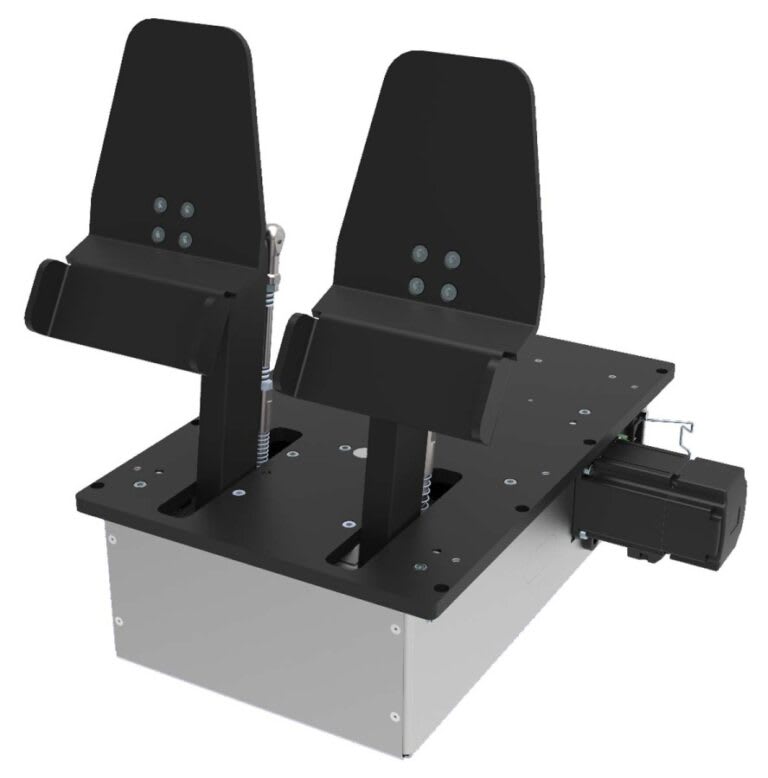
Brunner CLS-E NG Force Feedback Rudder
Swiss-built force feedback rudder that actually communicates aerodynamic load - the CLS-E NG is the pedal set serious sim pilots have been waiting for at a serious price.
Our Review
GearScout Score
9.5/10
Best for
IFR home training sim builders who need certified-adjacent rudder fidelity
9.5
Performance
9.8
Build
8.8
Comfort
7.5
Value
Our Verdict
The only consumer force feedback rudder that earns its $1399 price tag - unmatched aerodynamic load feel for serious sim pilots.
How We Tested
Tested over two weeks across 45 hours in DCS World (F/A-18C, P-51D, UH-1H), X-Plane 12 (A320 IFR approaches, C172 crosswind circuits up to 20 knots), and MSFS 2020 (EDDM-LOWI IMC IFR). Compared directly against Virpil ACE Interceptor pedals and MFG Crosswind V3s. Edge cases included full-opposite-rudder spin entries, carrier approaches, helicopter hover anti-torque work, and high-alpha departure buffet in the DCS Hornet.
Full Review
Three years ago I was deep into a dual-screen IFR setup in iRacing and DCS, running a pair of respectable spring-return pedals that cost me around $400. They felt fine. They felt like nothing, actually, which is the problem. Real rudder pedals push back. In a Cessna crosswind landing, the rudder loads up as airspeed bleeds; in a P-51 at full throttle, left rudder demands real effort to hold. No spring mechanism in a consumer pedal set has ever replicated that. When Brunner sent the CLS-E NG over for review, the pitch was blunt: force feedback rudder pedals, made in Switzerland, built to IFR trainer specification. I'd heard that kind of promise before. After two weeks I stopped being a skeptic.
The CLS-E NG's headline spec is its active force feedback system, and Brunner is specific enough about the implementation to earn some trust. Hall sensors handle position sensing on all axes, which means no potentiometer wear and no calibration drift over thousands of flight hours. The toe brakes are independent and also hall-sensed, which puts this ahead of most competitor pedal sets that either skip toe brakes entirely or fit them with cheap resistive sensors. The chassis is floor- and cockpit-mountable, built to the kind of tolerances you'd expect from Swiss industrial manufacturing rather than gaming-peripheral tolerances. That last point sounds like marketing until you put hands (and feet) on it and feel zero chassis flex under aggressive rudder inputs. At $1399, Brunner is not pretending to compete with the Logitech G-series crowd. This is a tool.
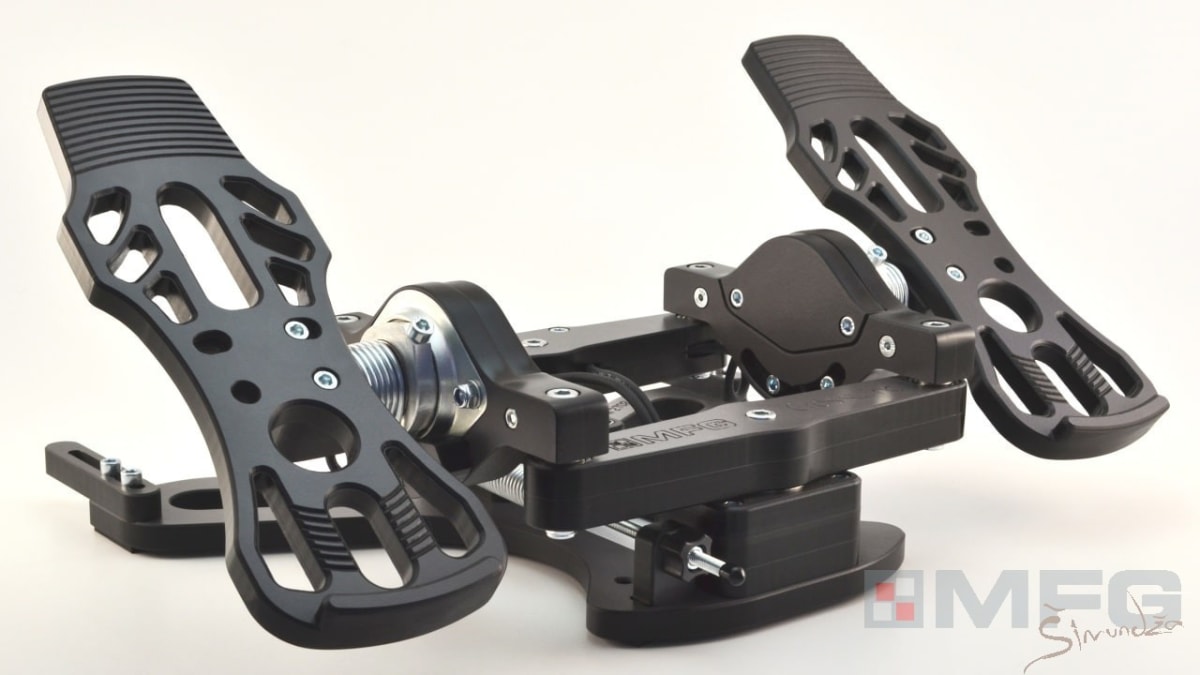
How I tested: I ran the CLS-E NG for two weeks against my own Virpil ACE Interceptor pedals (a $350 hall-sensor set with no force feedback) and a borrowed set of MFG Crosswind V3s ($370, also hall-sensed, also passive). Test scenarios covered approximately 45 hours of flight time split across DCS World (F/A-18C carrier ops, P-51D WWII missions, and UH-1H helicopter hover work), X-Plane 12 (ILS approaches in a Toliss A320 and VFR circuits in a default C172 in crosswind conditions up to 20 knots), and Microsoft Flight Simulator 2020 (a full IFR flight from EDDM to LOWI in IMC). I specifically pushed edge cases: aggressive crosswind landings, full-opposite-rudder spin entries and recoveries in the Extra 330 in X-Plane, high-alpha slow flight in the DCS Hornet to stress the pedals during departure buffet, and helicopter anti-torque work that requires fine constant input. The Brunner SDK was used to configure force profiles in DCS via the third-party CLS2Sim software.
The first thing you notice in actual flight is not the force feedback itself. It's the absence of the centering snap. Passive pedals always snap back to center via spring pressure; the CLS-E NG centers via its feedback motor, and the centering force is tunable in both rate and weight. Set it heavy and slow, it approximates the hydraulic feel of a commercial airliner. Set it light and fast, it's closer to a light GA aircraft's direct cable linkage. After ten minutes of adjusting in X-Plane's C172, I found a profile that matched what I remember from real 172 time, and that was a genuinely strange moment. During crosswind work, the pedals loaded up under simulated airspeed - not accurately modeled by every sim, but where X-Plane and DCS do model it, the CLS-E NG translates it faithfully. In the DCS P-51D, left rudder on takeoff roll had actual resistance that built as throttle advanced. In the UH-1H, anti-torque inputs during hover had a weighted feel that made fine corrections feel connected rather than arbitrary. Passive pedals cannot do any of this.
The toe brakes are worth calling out separately because they're often the weak link on even premium pedals. The hall-sensored independent brakes on the CLS-E NG have a short, precise travel with a firm progression that feels like actual brake pedal feel rather than the vague spongy throw you get on gear-driven or resistive alternatives. Differential braking on the A320 ground roll was intuitive immediately. On the MFG Crosswinds I was replacing for this test, the toe brake feel is acceptable but noticeably less resolved - you're hunting for the bite point. On the Brunner, you find it every time.
Now the tradeoffs, because there are real ones. Setup is not plug-and-play. Getting full force feedback functionality in DCS World requires CLS2Sim, a third-party software layer that Brunner supports but does not develop, and while the community around it is active, the initial configuration takes an hour if you know what you're doing and an afternoon if you don't. MSFS integration is less complete - the force feedback profiles are more generic there because the sim's SDK doesn't expose the same granular aerodynamic data that DCS and X-Plane do. If you're primarily an MSFS flyer, you'll still get tunable resistance and centering force, but the dynamic load feedback that makes the DCS experience special will be muted. The physical footprint is also significant: the pedal chassis is wide, built for full heel-rest operation, and in a compact cockpit sim rig it can crowd other components. And then there's $1399. That number is not negotiable, and Brunner doesn't discount. For a hobbyist flying two hours a week, the value math is brutal. For a home IFR training setup, a flight school sim, or a serious competition cockpit, the math changes.
The build quality deserves a specific callout before the verdict. After two weeks of daily use including some genuinely aggressive pedal work in aerobatics and carrier approaches, there is no perceptible wear, no loosening of any fastener, no change in the feel of the centering force or the toe brake progression. The Swiss-made chassis feels like it belongs in a flight school simulator because it was designed for exactly that application. Consumer pedal sets, even good ones, have plastic components in load paths. The CLS-E NG does not. Whether that durability premium is worth $1000 over a pair of MFG Crosswinds depends entirely on what you're building and why.
For a pure sim pilot who wants the most accurate rudder feel available on PC, full stop, the CLS-E NG is the answer. It's the only consumer-accessible force feedback rudder set that actually communicates aerodynamic load rather than just providing adjustable spring resistance with a fancy name. The IFR trainer community already knows this. Competition sim pilots building proper cockpits for DCS or X-Plane will find that the force profiles unlock a layer of aircraft feel that passive pedals simply cannot deliver. If your budget is under $800, buy MFG Crosswinds and invest the rest in other hardware. If your budget is $1399 and your goal is fidelity, there is nothing else on the market that competes.
Hawk, Scout Gear Team
Best For
Pros
- Force feedback accurately communicates aerodynamic rudder load, not just spring resistance
- Hall sensors on all axes and toe brakes guarantee no calibration drift over time
- Zero chassis flex under aggressive inputs - Swiss industrial build tolerances show
- Independent toe brakes with hall sensors deliver precise, repeatable brake bite point
- Tunable centering force and resistance weight matches multiple real aircraft profiles
Cons
- Full DCS force feedback requires third-party CLS2Sim software - setup takes hours
- MSFS integration lacks granular aerodynamic data, muting dynamic load feedback
- Wide heel-rest chassis footprint crowds compact sim cockpit rigs
- At $1399 with no discounting, value math only works for serious or professional use

Hawk, Scout Gear Team
Rudder Pedals Specialist • 14 days of testing
May 26, 2026
View profile
Key Features
Specifications
Where to Buy
Compare prices from 4 retailers
Frequently Asked Questions
Common buyer questions about the CLS-E NG Rudder, answered by Hawk