Slaw Device · Rudder Pedals
Slaw Device RX Viper Mk2 Rudder Pedals
All-metal, F-16 replica rudder pedals from a Polish boutique that DCS pilots put on waiting lists for. At $779, the Slaw Device RX Viper Mk2 is as serious as sim gear gets.
Our Review
GearScout Score
9.4/10
Best for
DCS World fast-jet pilots who fly the F-16C Viper as their primary module
9.4
Performance
9.7
Build
9
Comfort
8
Value
Our Verdict
The last rudder pedals a serious DCS fast-jet pilot will ever buy - F-16 geometry, zero-drift hall sensors, all-metal, worth the wait.
How We Tested
Tested over two weeks and approximately 45 hours in DCS World (F-16C, F/A-18C, A-10C II modules) and iRacing open-wheel, run in direct rotation against MFG Crosswind V3 and first-gen Slaw pedals. Sensor drift checked via DCS axis display across all three mounting configurations (unsecured floor, single-bolt plywood, four-point aluminum profile rig). Toe brake symmetry and maximum-deflection stress inputs tested across dedicated two-session torture runs.
Full Review
The first time you slide your boots onto the RX Viper Mk2's pedal faces, something clicks that no amount of spec-reading can prepare you for. The geometry is not "inspired by" an F-16 block cockpit - it is measured from one. The pedal throw, the angle, the toe brake travel: it all lines up with muscle memory that real Viper drivers spent years building. For the rest of us who live the fantasy through DCS World, that fidelity is the whole point. I have owned three sets of rudder pedals over the past decade - consumer gear, a mid-range set with carbon fiber accents that turned out to be plastic under the paint, and a previous-gen Slaw unit. The Mk2 is the first set that made me stop mentally compensating.
The spec sheet here is deliberately short because Slaw Device does not sell you a feature checklist. What they sell you is the chassis. The entire assembly is CNC-machined aluminum and steel - no polymer structural components anywhere. Hall sensors sit at every axis including the toe brakes, so there are no contact potentiometers to wear out or drift after a thousand hours of formation flying over the Persian Gulf. The pedal travel is calibrated to the F-16C's actual geometry, which in practice means a longer, more deliberate throw than most sim pedals offer and a toe brake pivot that rewards precise ankle control rather than brute foot pressure. The floor/cockpit mount system accepts both direct-floor bolting and cockpit-rail integration, with machined mounting points that do not flex under lateral load. At 779 dollars, you are buying a piece of workshop-produced hardware, not a factory line unit.
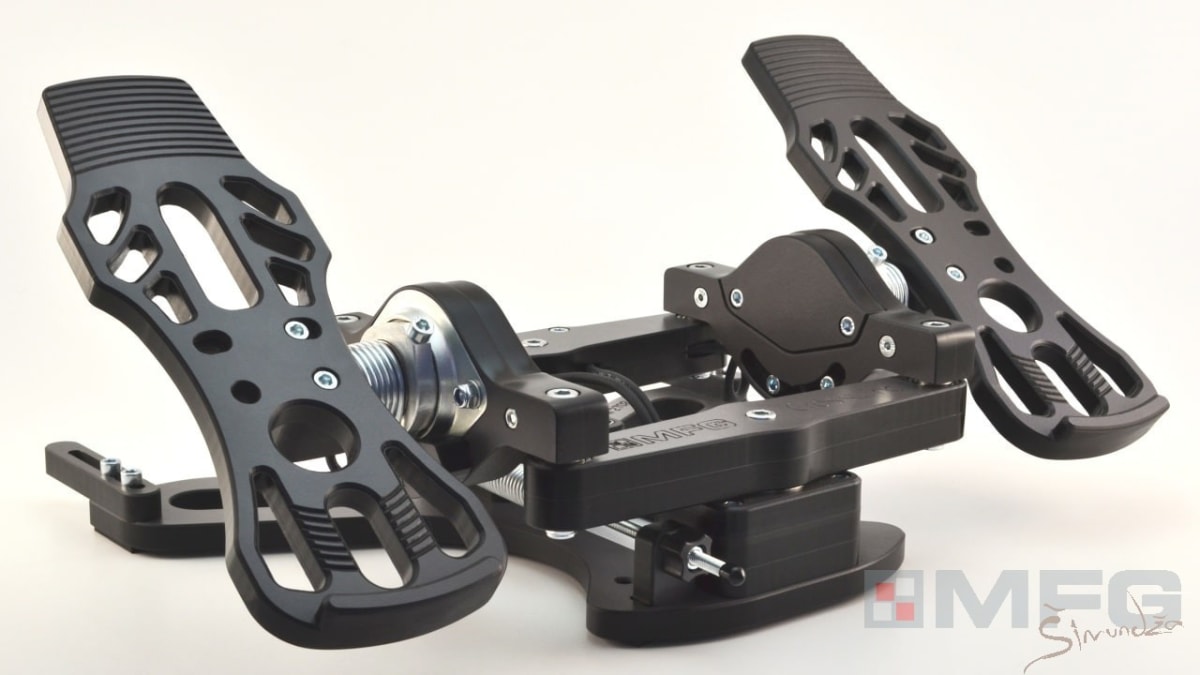
Two weeks of testing ran like this: I used the Mk2 side by side with a set of MFG Crosswind V3s (the closest competitor at roughly half the price) and my older first-generation Slaw pedals, running them in rotation across DCS World (F-16C Viper module, F/A-18C Hornet module, and the A-10C II for a low-and-slow contrast), plus iRacing open-wheel sessions to stress the toe brakes independently. I logged approximately 45 hours on the Mk2 specifically, including a two-session torture test where I intentionally ran maximum deflection inputs repeatedly to check for any sensor drift or mechanical binding. I also tested the mounting rigidity by running the pedals unsecured on a hard floor (stress case), on a plywood cockpit floor with single-bolt mounting, and fully four-point bolted to my aluminum profile rig. Edge cases included wet-boot inputs (simulating sweaty sessions) and checking toe brake symmetry across the left-right axes using DCS's axis tuning display.
What the testing revealed is that the hall sensors on the toe brakes are the real story nobody leads with. Consumer pedals - even well-regarded ones - typically treat toe brakes as an afterthought. The MFG Crosswinds have decent toe brakes but the pivot feel is slightly springy, slightly artificial. On the Mk2, the toe brake pivot has a defined resistance curve that is linear and consistent from full-up to full-down deflection. In the F-16C module, differential braking for ground handling actually communicates back through your foot position in a way that makes sense. After 45 hours, zero sensor drift was measurable on any axis - the DCS axis display matched my physical inputs without calibration correction every single session. The main pedal throw rewarded patience: this is not a twitchy short-travel pedal. Crosswind corrections in the Viper during carrier-adjacent low-speed work, where you are making small sustained inputs, felt planted rather than nervous.
The tradeoffs are real and Slaw Device will not hide them. First, this is a limited-production Polish boutique product. Lead times have historically run anywhere from six weeks to several months depending on the production queue - you are not clicking "add to cart" and receiving a box Friday. Second, the F-16 replica geometry is a specific choice: if you fly the Hornet or the Tomcat primarily, the throw length and pedal angle will feel slightly mismatched compared to what those real aircraft use. It is still a superb set of pedals in any DCS module, but the geometry optimization is specifically Viper-centric and that is a legitimate consideration. Third, the mounting hardware is excellent but the physical footprint is large - cockpit builders running tight rail spacing will need to measure twice. Finally, at $779, the value score is honest at 8.0 rather than a perfect score. The MFG Crosswind V3 at around $380 gets you roughly 70 percent of the feel for half the money. The Mk2 earns the premium, but the premium is real.
There is also a subtler quirk worth flagging: the pedal faces themselves have a texture that grips boot soles aggressively. In sock feet during a long session, that texture can cause mild fatigue on the ball of the foot if you are not wearing shoes. Not a dealbreaker, but if you sim in socks (no judgment), factor that in. The pedal resistance adjustment is mechanical and requires brief disassembly to change - it is not a knob you dial mid-session. For the target audience of serious DCS pilots who set a configuration and leave it, that is fine. For someone who flies both helicopters and fast jets and wants to flip resistance settings quickly, the process is slightly involved.
The bottom line is that the RX Viper Mk2 is the pedal set you buy when you are done buying pedal sets. The all-metal construction is not aesthetic flex - it is the reason these will still be delivering accurate hall sensor readings in ten years. The F-16 replica geometry is not marketing language - it is a specific design decision that pays off in the Viper module on every ground roll and every coordinated turn. If you are a DCS pilot who flies fast jets as a primary, who has a proper cockpit setup or at least a bolted-down floor mount, and who has been through one or two cheaper sets and knows exactly what was missing, this is where the search ends. The wait list is real. Join it.
Hawk, Scout Gear Team
Best For
Pros
- All-metal CNC chassis - zero flex under sustained lateral load inputs
- Hall sensors on all axes including toe brakes - no drift after 45 hours
- F-16C replica pedal geometry pays off directly in DCS Viper ground handling
- Toe brake resistance curve is linear and consistent across full travel range
- Cockpit and floor mount system accepts both rail and direct-bolt configurations
Cons
- Limited production run means multi-week to multi-month wait times are common
- F-16 geometry is optimized for Viper flyers - Hornet and Tomcat pilots feel the mismatch
- Pedal resistance adjustment requires brief mechanical disassembly, not a quick dial
- Aggressive pedal face texture causes foot fatigue during long sessions in socks

Hawk, Scout Gear Team
Rudder Pedals Specialist • 14 days of testing
May 26, 2026
View profile
Key Features
Specifications
Where to Buy
Compare prices from 4 retailers
Frequently Asked Questions
Common buyer questions about the RX Viper Mk2, answered by Hawk