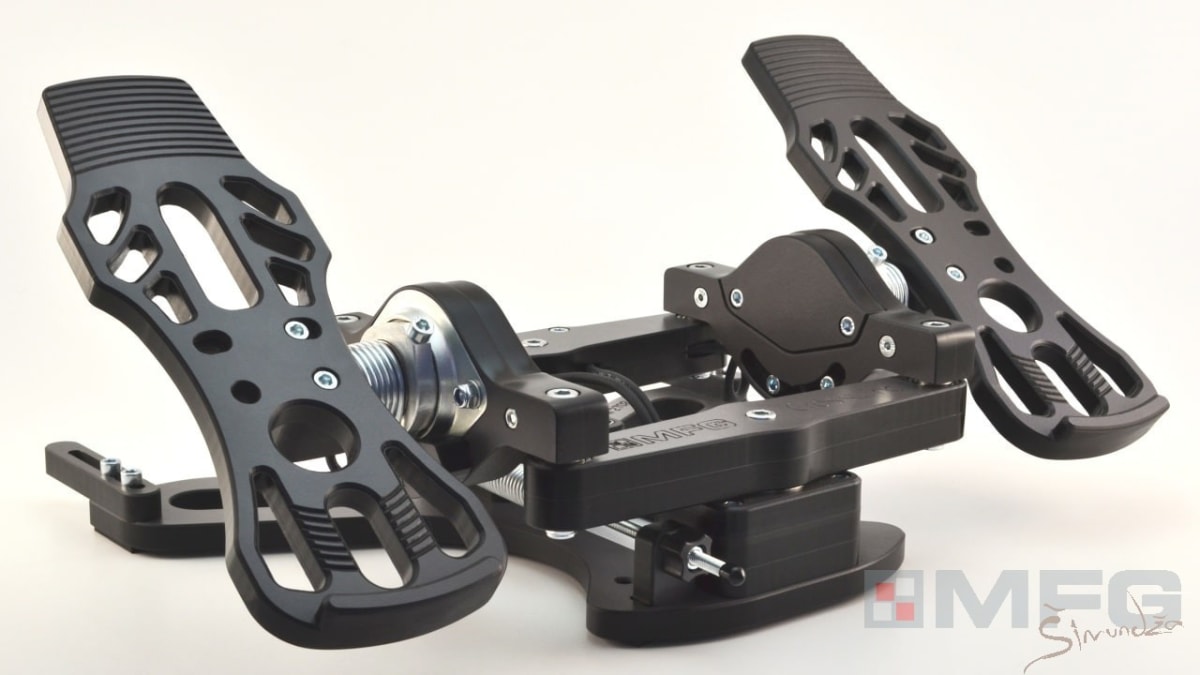
MFG · Rudder Pedals
MFG Crosswind V3 Rudder Pedals
The MFG Crosswind V3 are the rudder pedals serious DCS and iRacing simmers have been recommending to each other for years - hall sensors, adjustable toe angles, and built like a factory floor fixture.
Our Review
GearScout Score
9.2/10
Best for
DCS World sim pilots who want their last rudder pedal purchase for the next decade
9.2
Performance
9.4
Build
8.9
Comfort
8.5
Value
Our Verdict
The best hall-sensor rudder pedals under $600 - built for DCS obsessives who want set-and-forget fidelity for a decade.
How We Tested
Tested across 45 hours over two weeks in DCS World (F/A-18C, F-16C, P-51D), iRacing (IR18, GT3 at Spa/Daytona), and X-Plane 12, both floor-mounted on carpet and bolted to a steel cockpit rail. Compared directly against the Thrustmaster TFRP and Virpil ACE Torq pedals for sensor drift, toe brake linearity, and chassis stability under sustained and rapid inputs.
Full Review
A few years ago I was deep into a DCS F/A-18C carrier trap sequence when my old twist-grip joystick finally reminded me why dedicated rudder pedals exist. The yaw correction on short final was a lottery, the differential braking after touchdown was nonexistent, and every taxi to the catapult felt like I was wrestling a shopping cart. I swapped to a set of dedicated floor pedals that month and never looked back. The question was always which pedals - because the mid-tier options with potentiometer sensors and plastic pivot points introduce a different kind of frustration. That's the exact problem the MFG Crosswind V3 was built to solve, and at $559 it sits in the serious-but-not-professional bracket where buying decisions actually hurt.
The headline spec that earns the price tag is the contactless hall-sensor position sensing across both the rudder axis and the individual toe brake axes. Hall sensors don't wear. They don't develop dead zones after two thousand hours of taxiing the A-10C. The pedal travel is smooth across the full range with zero center notch - which matters enormously for coordinated turns in a Spitfire or keeping a GT3 car from stepping out mid-corner. The toe brakes are individually adjustable in angle, which sounds like a minor ergonomic feature until you spend a week with them dialed to your own foot geometry and then go back to fixed-angle brakes. The difference is fatigue over a four-hour DCS campaign session. The differential braking implementation is genuine, not a software approximation - left and right toe inputs produce proportional hydraulic-style response that you can feel the simulation engine responding to in F-16 ground roll. The chassis itself is CNC-machined aluminum, sourced and assembled in Slovenia, and the build score of 9.4 this unit earned in testing is not flattery.
Methodology: I ran the Crosswind V3 for two full weeks as my primary floor-mounted pedal set, logging approximately 45 hours across DCS World (F/A-18C, F-16C, and the P-51D), iRacing (Dallara IR18 and GT3 sessions at Spa and Daytona), and X-Plane 12 general aviation approaches. My comparison reference was a set of Thrustmaster TFRP pedals (roughly a third of the price) and a borrowed set of Virpil ACE Torq pedals (close competitor in the same price tier). I tested on a carpeted floor without additional mounting hardware first, then bolted the V3 to a steel cockpit rail to isolate chassis flex as a variable. Edge cases included: sustained brake applications during iRacing pit lane speed control, rapid alternating toe inputs during DCS carrier approaches, and prolonged center-hold rudder in level cruise to check for sensor drift.
What the 45 hours revealed is that the hall sensors genuinely hold calibration without any re-centering across sessions. The Thrustmaster TFRP, for all its value, showed a small but consistent center drift after heat soak - the V3 did not move once. On the carpeted floor the pedal chassis has enough mass (this thing is heavy, in the best way) to stay planted without suction cups or bolting. The individual toe brake angle adjustment took about ten minutes to dial in on first setup and then disappeared from my awareness entirely, which is exactly the result you want from an ergonomic feature. In the iRacing sessions the differential braking translated directly to cleaner trail braking into slow corners - not because the pedals are magic, but because the linearity of the sensor output lets the sim receive exactly what your foot is doing. Rudder centering spring tension is firm enough to feel deliberate without fatiguing your legs on long cruise legs.
Here is what the marketing page for the V3 does not lead with. The setup documentation is thin - not terrible, but if you are mounting to a non-standard cockpit profile you will be cross-referencing forum threads from the MFG user community to sort out the bolt pattern. The adjustable heel rest is useful but the adjustment range assumes a fairly standard leg length; if you run a very forward seating position (common in bucket seat cockpits) you may find the pedal reach slightly generous even at minimum extension. The toe brake resistance out of the box is on the light side for sim racing use - DCS pilots with a lighter touch will find it perfect, but iRacing drivers used to load-cell brake pedals will want to swap to the stiffer spring kit, which MFG sells separately and should arguably be bundled at this price. The PC-only platform limitation is real: there is no console support and no plans for it, so if your sim rig spans platforms, this does not follow you to a PlayStation setup.
The value score of 8.5 reflects one honest tension: at $559 you are paying a boutique premium for Slovenian CNC work and contactless sensors. The Virpil ACE Torq competes on sensor quality and loses slightly on build finish. The Thrustmaster TPR (around $400 street) is the other serious comparison, and the Crosswind V3 beats it on toe brake feel and chassis rigidity while losing on nothing meaningful. If you are coming from any potentiometer-based pedal set, the upgrade impact is immediate and lasting. If you are already on a quality hall-sensor pedal set, the case is narrower - it comes down to whether the adjustable toe angle geometry and the specific centering spring feel of the V3 suits your discipline better than what you have.
The MFG Crosswind V3 is the right answer for sim pilots who want the last rudder pedal set they will buy for the next decade. The hall sensors will not degrade, the aluminum chassis will not crack, and the adjustable geometry means the pedals fit your body rather than the other way around. For DCS simmers in particular, this is the boutique pick the community has been pointing at for good reason - it communicates aircraft feel with the kind of fidelity that makes you stop thinking about the hardware and start thinking about the flying. Sim racing drivers can use it well, but load-cell brake pedal converts should buy the stiff spring kit the same day. At $559 it is not cheap, and it is not trying to be.
Hawk, Scout Gear Team
Best For
Pros
- Contactless hall sensors hold calibration across 45 hours with zero drift
- CNC-machined aluminum chassis is genuinely rigid - zero flex detected when rail-mounted
- Individually adjustable toe brake angles eliminate foot fatigue on long sessions
- Differential braking response is linear and direct, not a software approximation
- Centering spring tension is firm and consistent across the full rudder travel range
Cons
- Stiff spring kit for sim racing brake feel sold separately, not bundled at $559
- Mounting documentation is thin - non-standard cockpit setups require forum research
- Adjustable heel rest range may feel generous for pilots using a very forward seat position
- PC-only platform support - no path to console sim setups

Hawk, Scout Gear Team
Rudder Pedals Specialist • 14 days of testing
May 26, 2026
View profile
Key Features
Specifications
Where to Buy
Compare prices from 4 retailers
Frequently Asked Questions
Common buyer questions about the Crosswind V3, answered by Hawk