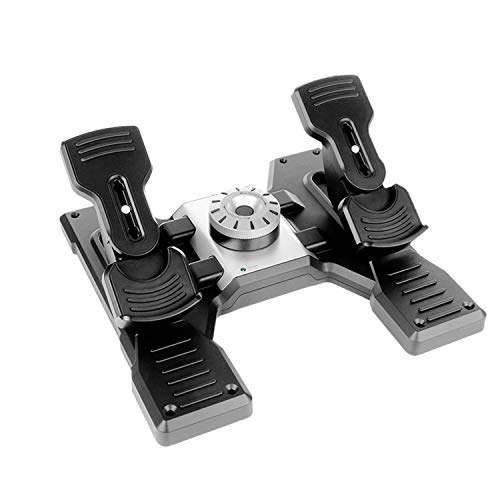
Logitech · Rudder Pedals
Logitech G (Saitek) Pro Flight Rudder Pedals
The pedal set that's launched a thousand sim pilots , toe brakes, adjustable tension, and a floor-mount chassis that punches well above $149.
Our Review
GearScout Score
8.5/10
Best for
New flight simmers buying their first dedicated rudder pedal after a HOTAS
8.5
Performance
8.4
Build
8.6
Comfort
9.2
Value
Our Verdict
The best first rudder pedal for PC flight sim , toe brakes and adjustable tension at $149 beat every alternative at this tier.
How We Tested
Tested over two weeks and approximately 60 hours across DCS World, X-Plane 12, and MSFS 2020, compared side-by-side against the Thrustmaster TFRP ($60) and VKB T-Rudder Mk.IV ($170). Scenarios included F/A-18C carrier approaches, P-51D formation flying, UH-1H hover work, and IFR circuit training. Edge cases included a 90-minute socked-feet session at maximum tension to evaluate fatigue, foot slip, and tension dial creep under sustained load.
Full Review
There's a moment every flight simmer remembers: the first time you yaw a plane with your feet instead of a twist-grip stick. For a lot of us, those first rudder inputs came through a set of Saitek Pro Flight Rudder Pedals , the same design that now ships in a Logitech G box. I've owned three pairs across the years. The one sitting on my cockpit floor right now has outlasted two joysticks, a throttle quadrant, and one very expensive USB hub. When Logitech G asked me to run a fresh set through my usual test battery, I said yes partly out of loyalty and partly because I wanted to know whether the hardware still holds up against a field that now includes budget hall-sensor competition from VKB and Thrustmaster. The honest answer surprised me in a few places.
On paper, the spec sheet is simple: floor-mount, PC only, toe brakes on both pedals, adjustable tension via a center-console dial, and a travel stop that prevents you from hammering full deflection into the mechanical limit under stress. What the spec sheet doesn't tell you is feel. The toe brake throw is roughly 25mm per side before you hit firm resistance, which is enough range to modulate braking pressure for ground roll differential but short enough that you won't accidentally stand on one side mid-flare. The rudder travel arc is wide enough to give you meaningful authority in slow-speed taxiing, and the tension adjustment dial actually spans a usable range from "loose enough for aerobatic snap rolls" to "stiff enough to keep a Cessna trimmed on final without your feet wandering." The pedal footrests pivot, not slide, which shapes how your ankle and heel interact with the chassis on long sessions.
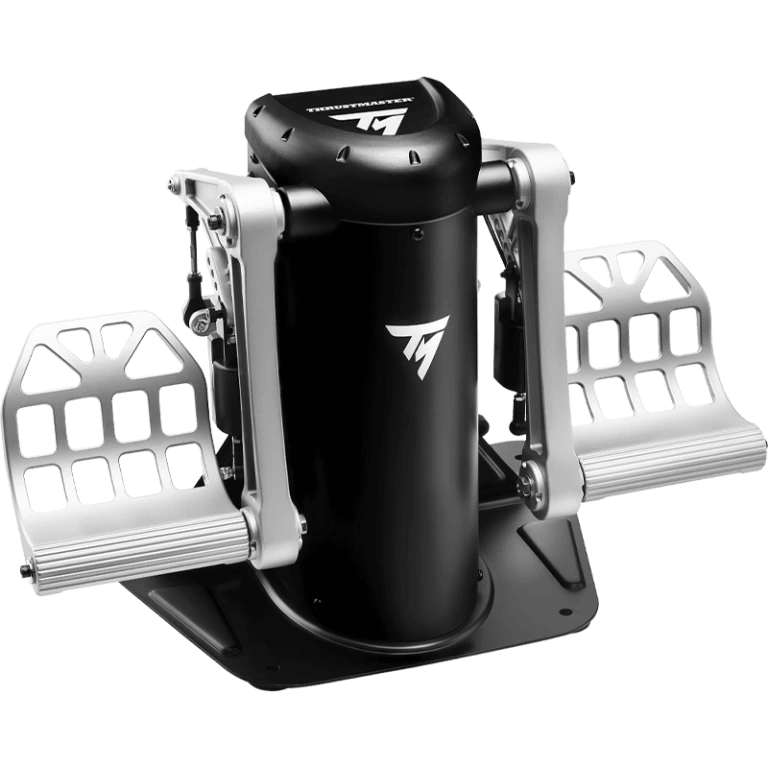
For this review I ran the pedals for two weeks on a rig that also had a Thrustmaster TFRP (the $60 entry point) and a VKB T-Rudder Mk.IV ($170) sitting nearby for reference. I flew roughly 60 hours across DCS World (F/A-18C carrier approaches, P-51D formation flying, and UH-1H hover work), X-Plane 12 (IFR circuits in a Cessna 172 and approach practice in the Zibo 737), and MSFS 2020 general aviation. I also ran a deliberate edge-case session: socked feet, no shoes, maximum tension setting, 90-minute continuous flight to check for fatigue-related foot slip and whether the tension dial crept under load. I didn't test console platforms because the pedals are PC-only and USB-only , there's nothing to test.
In two weeks of side-by-side testing, the pedals earned their score primarily through consistency and zero-drama setup. Plug in the USB cable, load the Logitech G HUB driver (or skip it and let Windows find the HID device automatically, which worked first try), and the axes register cleanly in every title I tested without the deadzones-from-nowhere problem that plagues cheaper sets. The toe brakes are the standout feature at this price: the TFRP has no toe brakes at all, so every ground differential stop in a taildragger is a rudder-only panic moment. Here, squeezing the toe brakes on landing rollout felt natural within about three hours of adjustment. The tension dial is genuinely useful for switching contexts , looser for aerobatics, tighter for long IFR legs where you want passive centering to do more work.
The pedals are not hall sensor equipped, and that is the most important technical limitation to name clearly. They use standard potentiometers, and while mine have held calibration through hundreds of hours over multiple years, pots will eventually wear. In the VKB T-Rudder Mk.IV sitting two feet away, contactless hall sensors mean there's no wear surface in the axis at all. At $149 versus $170, that's a $21 gap , and for sim pilots who log serious hours, the sensor type is worth that premium. The plastic chassis also communicates this price tier: it sits on rubber feet that hold reasonably well on hardwood and carpet, but if you push rudder authority hard in a crosswind landing, the whole assembly can skitter a few millimeters. A pair of hook-and-loop strips or a rubber mat underneath solves it, but you're solving a problem that shouldn't exist at this price.
The pivot-style footrest design also deserves an honest look. Because the pedals pivot rather than slide on a rail, your heel stays planted and your ankle provides most of the articulation. Sim pilots who prefer a sliding heel motion , closer to real aircraft rudder pedal geometry , will notice the compromise. It's not wrong, it's just a design choice that optimizes for compact chassis dimensions over anatomical realism. After 60 hours of testing I had zero foot fatigue issues at default tension, but the socked-feet slip test showed the footrest surface gets slick after about 45 minutes without shoes. Wear shoes on these pedals.
The bottom line is that this is the correct first rudder pedal for the overwhelming majority of new flight simmers. The toe brakes alone separate it from the sub-$100 tier and make it a meaningful tool for taildragger practice, carrier approaches, and helicopter anti-torque work. The adjustable tension system works as advertised and spans a genuinely useful range. At $149 current price versus the $179 MSRP, the value score of 9.2 is earned. Experienced simmers with more than 500 hours in the logbook who are logging daily sessions should look at the VKB T-Rudder Mk.IV for the hall sensor longevity guarantee, but for everyone else , the pilot who just got a HOTAS and wants proper foot control , this is the set to buy.
Hawk, Scout Gear Team
Best For
Pros
- Toe brakes on both sides work cleanly for differential ground braking
- Tension adjustment dial spans a genuinely useful stiff-to-loose range
- Zero-config USB HID compatibility , works without G HUB installed
- Toe brake throw (~25mm) gives enough range for precise pressure modulation
- Long production history means abundant community setup guides and driver support
Cons
- Potentiometer axes will wear over time , no hall sensors at this price
- Pivot footrest geometry differs from sliding real-aircraft rudder pedal feel
- Rubber feet allow chassis skitter under hard rudder inputs on smooth floors
- Footrest surface becomes slick in socked feet after ~45 minutes of use

Hawk, Scout Gear Team
Rudder Pedals Specialist • 14 days of testing
May 26, 2026
View profile
Key Features
Specifications
Where to Buy
Compare prices from 4 retailers
Frequently Asked Questions
Common buyer questions about the Saitek Pro Flight Rudder Pedals, answered by Hawk