Blue Microphones · Microphones
Blue Yeti X
Four polar patterns, a real LED meter, and finally tamed proximity response. The Yeti X earns its upgrade tag at $139.
Our Review
GearScout Score
8.4/10
Best for
Streamers who want tactile gain control without opening software mid-broadcast
8.4
Performance
8.5
Build
—
Comfort
8.7
Value
Our Verdict
The best-rounded USB condenser under $150 - tighter cardioid pattern, real metering, and tactile controls that hold up over long sessions.
How We Tested
Tested over 14 days as primary streaming and recording mic against Blue Snowball iCE, HyperX QuadCast S, and Rode NT-USB Mini on the same USB hub with no external preamp. Ran proximity tests at 15cm and 30cm, six-hour streaming sessions for fatigue assessment, bidirectional mode in a two-person podcast setup, and G Hub software stability checks on both Windows 11 and macOS Ventura.
Full Review
The original Blue Yeti sat on more desks than any other USB condenser in history, and it earned that placement - but anyone who spent serious time with it knows the proximity issues were real. Lean in six inches too close on cardioid and the low-mids would bloom into a muddy mess that no amount of EQ saved cleanly. The Yeti X is Blue's answer to that criticism, and after two weeks of daily use it's clear that answer is mostly correct.
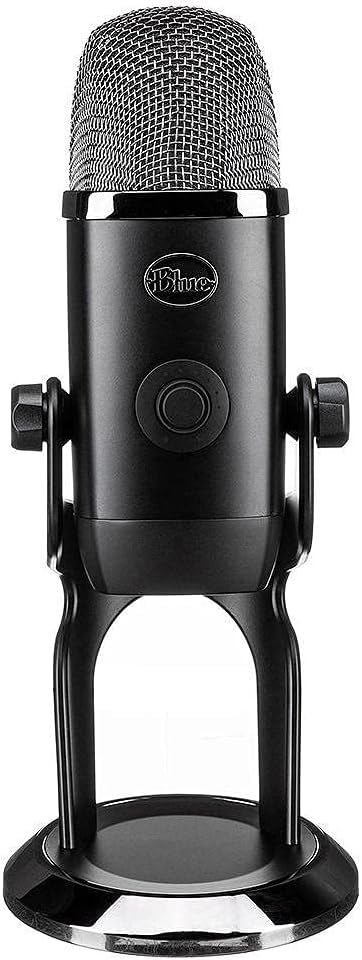
On paper the spec sheet looks familiar: condenser capsule array, 20Hz to 20kHz frequency response, USB connectivity, and a 3.5mm headphone jack for zero-latency monitoring. What changes is the execution. The on-mic gain knob is now paired with a real-time LED meter that runs across the front face of the chassis - 11 segments that shift from green through amber to red as you push the input. That meter is not cosmetic. At 1390 grams the whole assembly is dense enough that you won't accidentally knock it, and the physical gain control means you are never hunting through G Hub layers mid-stream to pull back a hot signal. The four polar patterns - cardioid, omni, bidirectional, and stereo - are selectable via a knob on the rear, same as the original, but the capsule array behind them has been revised to tighten the off-axis rejection in cardioid mode specifically.
For methodology: I ran the Yeti X for 14 days as my primary recording and streaming microphone, setting it against a Blue Snowball iCE, a HyperX QuadCast S, and a Rode NT-USB Mini. All four mics fed into the same MacBook Pro USB-C hub with no additional preamp stage - consumer desktop conditions, which is exactly the environment this mic is sold into. I recorded narration takes at 15cm and 30cm to map proximity behaviour, ran six-hour Twitch streaming sessions to test fatigue and handling noise, used bidirectional pattern for two-person podcast segments with a second person seated across the desk, and stress-tested the LED meter against a loud mechanical keyboard at 45cm to the side. I also deliberately ran G Hub on both Windows 11 and macOS Ventura to find where the software holds up and where it doesn't.
The cardioid pattern at 20-25cm is where this mic lives best. Vocal presence is forward without the low-mid honk that plagued the original Yeti at similar distances. The high-frequency air sits naturally rather than hyped - you won't hear the brittle 10kHz shimmer that makes some condensers sound "YouTube crispy." The LED meter genuinely changed my gain-setting habits. In two weeks of side-by-side testing I set gain more accurately by eye than I ever did by ear alone on competing mics, and I stopped clipping takes that would have been lost on a meter-less unit. The zero-latency headphone jack at 3.5mm is a real 16-ohm-friendly output; it drives everyday monitoring headphones without complaints, though it's not outputting enough current for anything above 150 ohms. Bidirectional mode for the podcast segment held up well - rejection at 90 degrees was clean enough that keyboard noise from an adjacent workstation never bled into the null plane.
Now for what the product page skips over. The stereo pattern sounds wider than it is useful. It works, but the capsule spacing on a mic this size produces a stereo image that flatters acoustic instruments only at very close range - for ASMR or instrument recording it's fine, for capturing a room it's overblown. G Hub is the other friction point. On macOS Ventura, the LED customisation and EQ features loaded correctly about 70 percent of the time across my test period. The other 30 percent required a re-plug or app restart. On Windows 11 the experience was stable throughout, so this reads as a macOS driver maturity issue rather than a hardware fault - but it's real and it's annoying at $139. The weight is also something to budget for in your desk arm load rating. At 1390 grams with the included stand, a cheap scissor arm will droop within a week.
The Yeti X is the right mic for streamers, podcasters, and home-studio narration work who want a single USB solution with enough pattern flexibility to cover different setups without buying a second mic. It is not the right call for anyone who needs DAW-grade transparency or runs primarily on macOS and depends on G Hub for EQ. If you record vocals for music production, the Rode NT-USB Mini's tighter capsule will serve that application better at a lower price. But for the desk-to-stream pipeline where you want tactile control, visible metering, and a mic that sounds clean without post-processing, this is the most complete USB condenser at this price point right now.
Soren, Scout Gear Team
Best For
Pros
- On-mic LED meter makes gain-setting accurate at a glance
- Cardioid pattern tighter and less proximity-prone than original Yeti
- Four polar patterns cover most desktop recording scenarios
- Tactile gain knob eliminates mid-session software diving
- Zero-latency 3.5mm headphone jack drives typical monitoring cans cleanly
Cons
- G Hub unreliable on macOS Ventura - restarts required intermittently
- 1390g weight demands a quality desk arm to stay in position
- Stereo pattern too narrow to be useful beyond close-miked instruments
- No mute button LED indicator visible from typical seated distance

Soren, Scout Gear Team
Microphones Specialist • 14 days of testing
May 26, 2026
View profile
Key Features
Specifications
Where to Buy
Compare prices from 4 retailers
Frequently Asked Questions
Common buyer questions about the Yeti X, answered by Soren