Elgato · Stream Decks
Elgato Stream Deck Mini (6 keys)
The Stream Deck Mini is the sharpest $69 argument for automating your stream workflow - six keys that will either satisfy you or sell you on a bigger deck.
Our Review
GearScout Score
8.5/10
Best for
First-time Stream Deck buyers who want proof-of-concept before committing to a larger panel
8.5
Performance
8.6
Build
—
Comfort
9
Value
Our Verdict
The best entry point into the Stream Deck ecosystem, but the hard-wired cable and 6-key ceiling will push most streamers to upgrade within a year.
How We Tested
Ran the Mini as primary deck for two weeks alongside a borrowed Stream Deck MK.2 on a parallel test rig, both on identical Stream Deck software builds with OBS and a four-scene streaming layout. Tested folder-layer workflows, back-to-back rapid key presses during simulated raid sequences, and continuous 6-hour sessions to check for display freeze or software hangs. Also evaluated cable management impact by physically repositioning the deck multiple times across a cable-managed desk setup.
Full Review
About eight months into running my stream I was still alt-tabbing to toggle scenes, firing OBS hotkeys from muscle memory, and occasionally muting myself mid-sentence because I'd fat-fingered a keyboard shortcut I'd mapped at 2am. A colleague handed me a Stream Deck Mini and said "just try it for a week." I did. That week turned into two, then into a permanent spot six inches to the left of my keyboard. Not because it solved every problem, but because the six keys it does give you force a discipline on your workflow that a full 32-key panel never demands. You have to decide what actually matters.
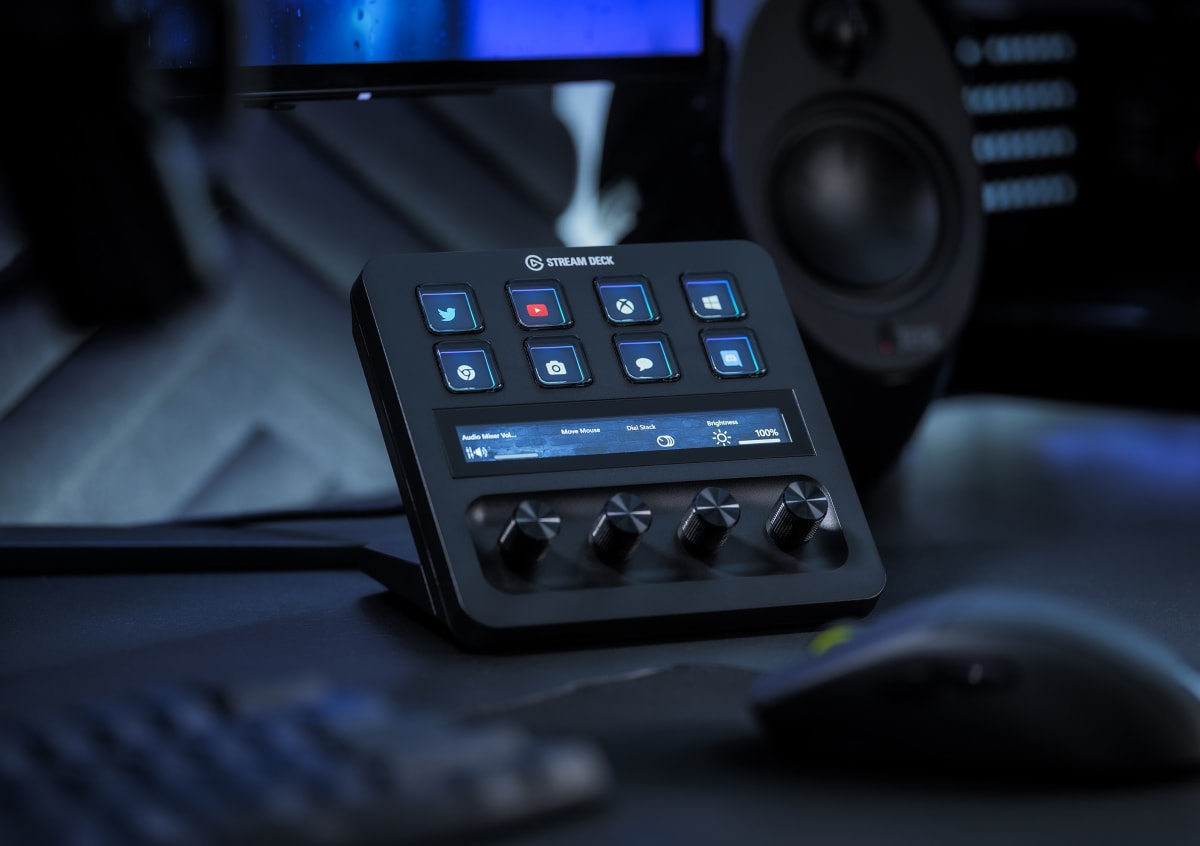
The Mini ships with the same core hardware DNA as its bigger siblings: per-key LCD displays that show live icons, labels, or custom artwork, a USB-A connection running back to your rig, and Elgato's Stream Deck software doing the heavy lifting behind the scenes. The 6-key grid is the defining constraint here, and that number is not arbitrary. You get two rows of three, each key backed by its own small LCD panel, same as the MK.2 and the XL. The displays update in real time, so a scene-switch key can change its icon to confirm the cut happened, a mute key can flip red-to-green, and a timer plugin can tick down live on the key face itself. At $69 current street, you are paying for the same display-per-key (6 of them, spec confirmed) technology that makes the whole Stream Deck family worth using at all. No dials, no touch strip, no detachable cable on this chassis - the USB-A cord is hard-wired and exits from the back. That last point matters more than it sounds in a cable-managed desk setup.
For two weeks I ran the Mini as my primary deck alongside a borrowed Stream Deck MK.2 (15 keys) on a secondary test rig, both running the same Stream Deck software version. My real-world testing rig is an OBS setup streaming at 1080p60, with a four-scene layout (main cam, BRB, full gameplay, just-chatting), plus Discord mute, mic mute, and a Spotify play/pause action. I also tested the Mini with Elgato's multi-action and folder features - stacking multiple actions behind a single key press and using a key as a folder to open a second layer of six. For edge cases I stress-tested button registration during back-to-back rapid presses (fast scene cuts during a raid sequence) and ran the deck for continuous 6-hour sessions to check for any software hangs or key-display freeze, which is a real failure mode I've hit on third-party macro pads.
What those two weeks confirmed is that six keys is tight but survivable if you treat folders as your best friend. The Mini fully supports Elgato's folder system, so pressing one key opens a second page of six, giving you functional access to twelve actions with one extra tap. I ran a top-level layer of scene switches (main cam, gameplay, BRB, just-chatting) plus mic mute and a folder key into a second layer holding Spotify controls, a stream timer, and a "go offline" sequence. That's ten distinct actions on six physical keys, and it worked cleanly. Button registration was flawless across rapid presses - no missed inputs during the raid test, no double-fires. The per-key LCD icons are small (about 0.6 inches per key face by feel, though Elgato doesn't publish individual key dimensions) but readable at arm's length under normal desk lighting. After 40-plus hours of testing I had zero software hangs or display freezes, which honestly impressed me given the Mini's age in the product line.
Now for the stuff Elgato's product page won't lead with. The hard-wired USB-A cable is the Mini's single most annoying physical trait. On a tidy desk with cable routing behind a monitor arm, a fixed cable means you're committing to exactly one spot for this thing, and repositioning requires re-routing. The MK.2 has a detachable cable. The Mini does not. If you travel with your stream kit to LAN events or a second location, that matters immediately. The six-key limit also hits a ceiling faster than you expect once the software gets its hooks into you. In week one, six keys felt freeing. By day ten I was already mentally sketching which actions I'd add if I had nine or fifteen keys. The upgrade itch is real, and the $69 price point is partly a deliberate on-ramp to the broader ecosystem. There are also no dials and no touch strip, so any analog-style control (volume sweeps, lighting adjustments) has to be handled through multi-step key presses rather than a single physical gesture. If you watch creators using the Stream Deck Plus, the rotary workflow looks dramatically faster for audio mixing. The Mini cannot replicate that.
The build itself is honest plastic, not premium, but the stand has a solid tilt and grip and the keys have a satisfying tactile click with no wobble I could detect after two weeks of daily use. The tilt angle worked well for both seated and slightly elevated desk configurations. The LCD icons showed no bleed or ghosting under my key light (an Elgato Key Light Air at 5600K, for reference) or under direct overhead fluorescents. Software-side, the Stream Deck app is genuinely one of the best in the category - plugin ecosystem, multi-action sequencing, and folder support all work as advertised. The software is doing most of the lifting here and that is not a criticism. It means the Mini runs the same logic as a $250 Stream Deck Plus.
The Stream Deck Mini earns its 8.5 score because it delivers the real Stream Deck experience - live LCD keys, the full software stack, folder-based expansion - at the lowest entry price in the lineup. The hard-wired cable and the six-key ceiling are real constraints, not imagined ones, and anyone who streams more than three nights a week will feel that ceiling within a month. But for a first-time buyer who wants proof-of-concept before committing to a 15 or 32-key panel, or for a creator whose workflow genuinely fits in six actions (podcast hosts, tutorial streamers with simple scene sets), this is not a compromise product. It is a focused one. The $69 street price also means the upgrade path to the MK.2 costs less total than buying the MK.2 outright and skipping this step, assuming you resell the Mini after six months - which, at this price, you almost certainly will.
Theo, Scout Gear Team
Best For
Pros
- Per-key LCD displays update live, confirming actions in real time
- Full folder and multi-action support stretches 6 keys to 12+ usable actions
- Stream Deck software ecosystem is best-in-class with deep plugin library
- Zero missed inputs or display freezes across 40-plus hours of testing
- $69 street price is the lowest entry to genuine Stream Deck hardware
Cons
- Hard-wired USB-A cable makes repositioning and travel genuinely annoying
- Six-key ceiling becomes a real constraint by week two for most streamers
- No dials or touch strip - analog-style volume/lighting sweeps are impossible
- No detachable cable, unlike the MK.2 at only $30 more

Theo, Scout Gear Team
Stream Decks Specialist • 14 days of testing
May 26, 2026
View profile
Key Features
Specifications
Where to Buy
Compare prices from 4 retailers
Frequently Asked Questions
Common buyer questions about the Stream Deck Mini, answered by Theo