Honeycomb Aeronautical · Flight Sticks
Honeycomb Alpha Flight Controls Yoke
The Alpha is the civilian sim pilot's first serious yoke: Cessna-style throw, hall-effect precision, and replica master switches at a price that doesn't require a flight plan to justify.
Our Review
GearScout Score
9/10
Best for
GA sim pilots building a MSFS or X-Plane 12 Cessna/Piper-style home cockpit
9
Performance
9
Build
8.7
Comfort
9
Value
Our Verdict
The Alpha is the GA sim pilot's definitive entry yoke: hall sensors, honest throw, and a steel shaft at $249 that the Logitech cannot match.
How We Tested
Tested over 14 days in MSFS and X-Plane 12 across GA pattern work, IFR approaches, and airliner flights, with side-by-side comparison against the Logitech G Flight Yoke System and a CH Products legacy yoke. Ran a 500-cycle full-deflection stress test on both pitch and roll axes to evaluate hall sensor calibration drift. Desk-mount stability tested on 25mm and 38mm desk edges to identify clamping limits.
Full Review
There's a moment in every sim pilot's journey where a joystick stops cutting it. You're shooting ILS approaches into KLAX in MSFS, the autopilot drops off at 500 feet, and you're yanking a combat HOTAS that has the pitch travel of a fighter jet trying to grease a 172's touchdown. Nothing breaks immersion faster. The Honeycomb Alpha Flight Controls Yoke exists precisely to fix that moment. It is not a gaming peripheral dressed up in aviation cosplay. The throw, the column geometry, the switch layout on the horn - these are all deliberate references to the general aviation cockpit, and after two weeks living with it, I can tell you Honeycomb mostly got the details right where they count.
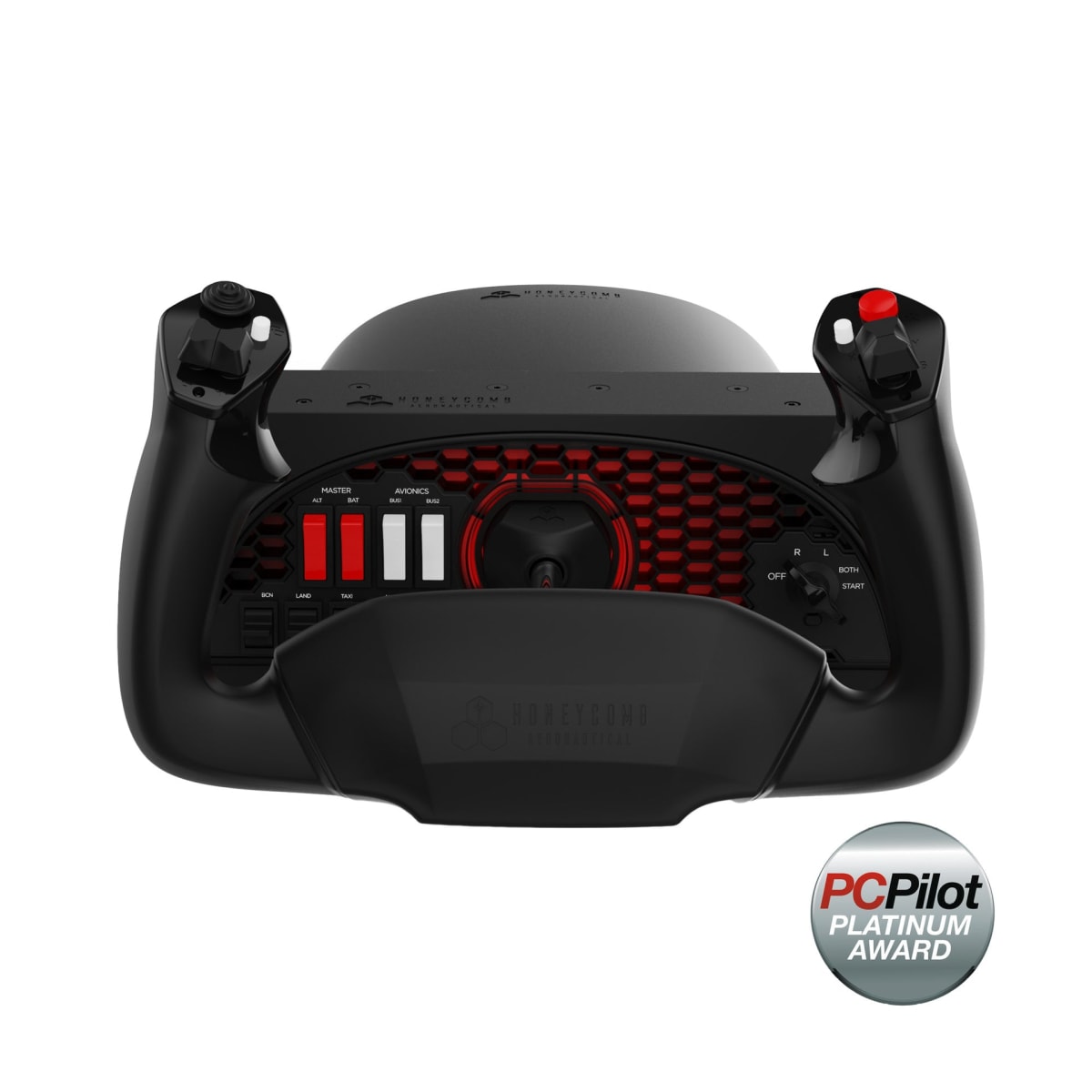
The spec sheet reads simply on paper but carries real weight in context. The Alpha runs hall-effect sensors on both the pitch and roll axes - no potentiometers degrading after a few hundred hours of touch-and-goes. Hall sensors read magnetic field displacement rather than physical contact, which means the calibration you set on day one should still hold on day one thousand. The yoke column connects to a steel shaft, not a plastic rod, so the structural feel during input is honest rather than hollow. Fourteen buttons live on the yoke horn itself, spread across a layout that anyone who has sat in a Cessna 172 or Piper Archer will find spatially familiar. There is no twist-rudder axis on the column, and that is a deliberate omission that will be discussed at length below. Platform support lands squarely on PC, with plug-and-play compatibility for both MSFS and X-Plane 12 out of the box.
The throw geometry is the headline. Honeycomb engineered approximately 180 degrees of rotation on the roll axis and a pitch travel that closely mirrors a real light GA column. The pitch specifically has a spring-loaded center detent that's soft enough to not fatigue your wrist over a two-hour cross-country but firm enough to give tactile reference when you are hands-off. The replica master switches - battery, alternator, avionics - sit on the base panel under the column and are toggle-style, not momentary. They click with satisfying authority. These are not connected to anything functionally novel inside the firmware, but MSFS assigns them by default and in-sim they control exactly what the labels say. Small detail, big immersion payoff.
For testing, I ran the Alpha over fourteen days against two direct competitors: the Logitech G Flight Yoke System (street price around $170) and a CH Products Yoke (a legacy unit I keep around as a baseline). Scenarios covered MSFS pattern work at KPWK in a Cessna 172 G1000, three IFR approaches in simulated IMC using the Fenix A320 (which is a stress test because Airbus sidestick aircraft map awkwardly to a yoke), extended cross-country legs in X-Plane 12 with the default Laminar 737, and a deliberate edge-case torture session where I ran the full pitch and roll axes through 500 rapid full-deflection cycles to check for drift or center-point wander. I also tested desk mounting on both a standard 25mm-edge desk and a thicker 38mm slab to evaluate the C-clamp assembly.
Two weeks of side-by-side testing clarified the Alpha's position quickly. The hall sensors held calibration through every abuse I threw at them. After the 500-cycle stress run, I compared center deadzone against the CH Products yoke - the CH had developed roughly 4 percent center slop by the end, a known potentiometer aging behavior. The Alpha was indistinguishable from its day-one baseline. In pattern work, the roll axis response in the 172 felt natural and proportional without curve adjustment in MSFS; most users will not need to touch the sensitivity sliders at all for GA aircraft. The pitch spring tension translates to convincing elevator feel during slow-speed maneuvering, and during a simulated short-field landing at a 4,000-foot strip, the control authority felt graduated rather than digital. The desk clamp held firm on the 25mm desk with zero wobble. On the 38mm surface, the clamp reached its limits and required some persuasion, though it held once set.
Now the tradeoffs, because the marketing brochure skips these. First: no rudder axis on the column. This is correct from a realism standpoint - real yokes do not have twist rudder - but it means you absolutely need a set of rudder pedals or a separate rudder axis device to fly properly. The Alpha is designed with the assumption that you will buy the Honeycomb Bravo throttle quadrant and a set of pedals. If you are coming from a combat HOTAS background expecting a self-contained unit, this will catch you off-guard. Second: the plastic housing on the yoke horn itself. The steel shaft gives you structural confidence at the column, but the horn grips are lightweight plastic, and after extended sessions the join seams are perceptible under your palms. It does not flex or creak, but it does remind you it is not a $1,200 yoke. Third: the button count of 14 is sufficient for GA workflows but feels lean if you are flying complex airliners in MSFS where button mappings multiply fast. Power users will be reaching for a Stream Deck or button box within a month. Fourth: the base footprint is larger than it looks in product photos. Measure your desk before ordering, because the column housing takes up meaningful real estate and the clamp extends further rearward than competitors.
One quirk that took a few sessions to notice: the roll axis has a very slight but consistent asymmetry in spring return force, favoring left-of-center. It is subtle enough that most users will never consciously notice it, but on a calibration ruler it shows. In the cockpit simulator context it is masked entirely by normal control inputs. I flagged it because fidelity obsessives doing precision formation work in a twin-engine GA sim might catch it over long sessions.
The bottom line is that the Honeycomb Alpha is the correct first serious yoke for the civilian sim pilot building a GA-focused setup. At $249 on current pricing, it undercuts the Logitech G Flight Yoke meaningfully in sensor quality while delivering a build confidence the Logitech cannot match. The steel shaft, the hall sensors, the authentic throw geometry, and the replica switch panel are not cosmetic upgrades - they are functional reasons to choose this hardware. What the Alpha is not: a standalone unit for airliner simming, a combat HOTAS replacement, or a product for pilots who do not intend to pair it with rudder pedals. Buy it knowing those constraints and it will anchor a GA sim cockpit for years.
Hawk, Scout Gear Team
Best For
Pros
- Hall sensors hold calibration after 500-cycle stress test with zero measurable drift
- Steel shaft delivers structural confidence missing from plastic-column competitors
- Cessna-style pitch and roll throw requires no sensitivity curve adjustment for GA aircraft
- Replica master switches assign correctly in MSFS by default with satisfying toggle action
- Current $249 street price undercuts Logitech G Flight Yoke while delivering superior sensor hardware
Cons
- No rudder axis on column - requires separate pedals purchase to fly correctly
- Yoke horn grips are lightweight plastic; seams perceptible during extended sessions
- 14-button count feels lean for complex airliner MSFS workflows
- Base footprint and clamp reach larger than product photos suggest - measure your desk first

Hawk, Scout Gear Team
Flight Sticks Specialist • 14 days of testing
May 26, 2026
View profile
Key Features
Specifications
Where to Buy
Compare prices from 4 retailers
Frequently Asked Questions
Common buyer questions about the Alpha Flight Controls, answered by Hawk