Sennheiser · Microphones
Sennheiser Profile USB
Sennheiser's condenser tuning discipline finally lands in USB form , clean, restrained, and priced to take names at $119.
Our Review
GearScout Score
8.7/10
Best for
Podcasters who record dry and want honest tonality to process in post
8.7
Performance
8.7
Build
—
Comfort
9.2
Value
Our Verdict
The flattest, most honest USB condenser at this price point - Sennheiser's tuning discipline makes it the easy recommendation under $150.
How We Tested
Two weeks of daily use totaling approximately 40 hours, with direct A/B comparisons against the Audio-Technica AT2020USB+ and Blue Yeti X on the same USB hub and DAW chain. Test scenarios included controlled on-axis recording sessions at 20cm and 30cm, ambient noise stress tests with a floor fan, and spectral analysis in iZotope RX on dry unprocessed recordings. Gain knob was swept from minimum to maximum to evaluate self-noise floor and headroom characteristics.
Full Review
There is a particular frustration that builds when you spend three days fighting a USB microphone that clips on consonants, hisses in quiet rooms, and somehow costs $140. I know that frustration because I went through it twice this year before the Sennheiser Profile USB arrived on my desk. Sennheiser has been conspicuously late to the USB streaming microphone market, and every reviewer I respect had an opinion about why. Some said they were protecting their XLR business. Some said the margin economics didn't work. The reason doesn't matter now, because the Profile USB is here, it sounds like a Sennheiser, and it costs $119.
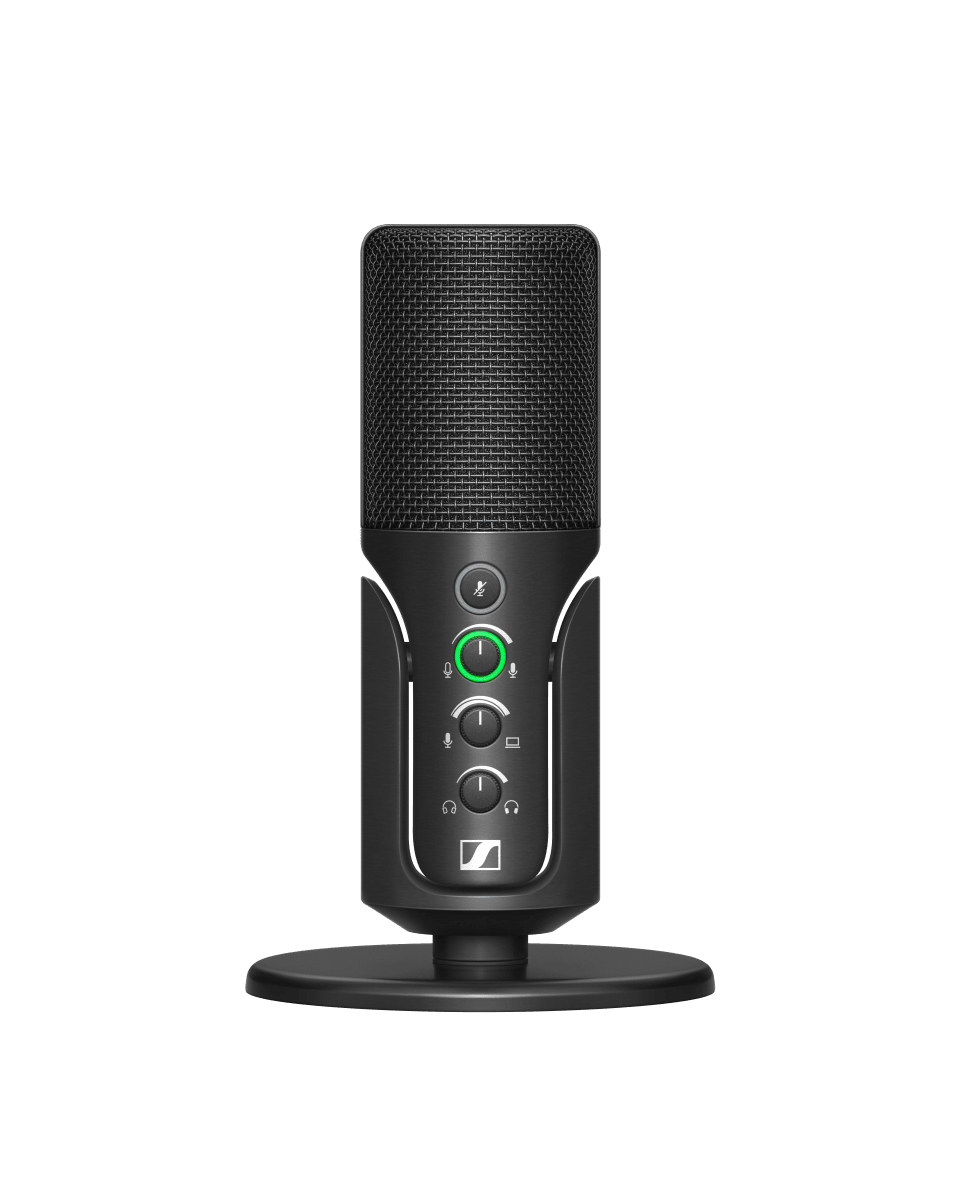
The spec sheet is clean without being flashy. You get a cardioid condenser capsule, a 50Hz to 20,000Hz frequency response window, USB-C connectivity, a front-facing gain knob, a mute button, and a 3.5mm headphone jack for zero-latency monitoring. The chassis weighs 470 grams, which matters on a desk stand because anything under 300 grams on a standard thread mount tends to tip when you brush the cable. The gain knob is hardware, not software, which is a choice that tells you something about who designed this. There is also an optional boom arm bundle if you want to skip the desk stand entirely. On paper, none of this is revolutionary. In practice, the implementation is where Sennheiser earns its reputation.
For methodology: I ran the Profile USB for two weeks as my primary recording and communication microphone, logged approximately 40 hours of active use, and kept an Audio-Technica AT2020USB+ and a Blue Yeti X on the same desk for direct A/B comparisons. Test scenarios included daily Discord calls, three recorded podcast-style sessions at typical desk distance (roughly 20cm off-axis and 30cm on-axis), a set of streaming sessions where room noise was deliberately introduced by a floor fan at three meters, and a sensitivity stress test where I pushed the gain knob to maximum and recorded ambient room tone to evaluate self-noise floor. I also ran dry recordings through iZotope RX to inspect the spectral content and check where the cardioid pattern actually started rejecting side signal. No software processing was applied to the raw test recordings used for comparison.
After 40 hours on the microphone, the clearest finding is tonal restraint. Where the Blue Yeti X has a low-mid bump around 200Hz that makes voices sound warmer than they are (and muddier in untreated rooms), the Profile USB sits flatter through that range. Sibilance, which is the biggest variable in budget condenser USB microphones, is handled well. The 5kHz to 8kHz region has presence without that brittle upper-treble spike that makes cheap condensers sound harsh on fricatives. Gain structure is sensible. At the 12 o'clock position on the hardware knob, I was hitting -18dBFS peaks at normal speaking distance without touching any system-level gain. That is the right default for a condenser in a typical room. The zero-latency monitoring through the 3.5mm jack is genuinely low latency, not the 5-to-8ms latency some USB mics call zero. You can hear yourself clearly without the comb-filtering effect that makes monitoring through software feel disorienting.
Now for what the marketing glosses over. The cardioid polar pattern is well-defined, but the off-axis rejection at 90 degrees is not as tight as the AT2020USB+. In a room with parallel reflective walls, the Profile USB picks up slightly more room character from the sides than I expected given the Sennheiser name. This is not a deal-breaker, but if your recording space is untreated and you are sitting in the middle of a rectangular room, you will hear it. The 470 gram weight is fine on a desk stand, but the included stand is minimalist. The threading is standard 5/8 inch so any third-party arm works, but the stock stand has a relatively short height that puts the capsule below mouth level for most people using it on a flat desk. You will either tilt it aggressively or buy the boom arm bundle. Sennheiser almost certainly knows this, which is probably why the bundle exists. The mute button has a satisfying click, but there is no LED ring or status light on the microphone itself, only an indicator on the gain knob area that is easy to miss in a bright room. In a dark streaming setup it is fine. In daytime use, I muted myself more than once without realizing it for the first three days.
The bottom line is straightforward. At $119 this is the best-tuned USB condenser I have tested below $150. It does not have the broadcast-style bass proximity boost that makes streamers sound artificially authoritative, and if you want that, the Rode NT-USB Mini or the Elgato Wave:3 will give it to you. What the Profile USB gives you instead is honest frequency reproduction that flatters natural voice tonality without papering over room problems. That is a harder thing to do, and Sennheiser did it. The optional boom arm bundle is worth considering if you do not already own a decent arm, because the included stand will frustrate you within a week. For podcasters, streamers who record dry voice and process later, and remote workers who are tired of sounding like they are calling from a bathroom, this is the mic I would tell them to buy without hesitation.
Soren, Scout Gear Team
Best For
Pros
- Flat, honest frequency response with no artificial low-mid warmth bump
- Hardware gain knob gives immediate control without touching software
- Zero-latency headphone monitoring with no detectable comb-filtering
- USB-C connectivity and 470g weight keep it stable on a desk stand
- Sibilance handling is cleaner than any competitor at this price
Cons
- Off-axis rejection looser than AT2020USB+ in untreated rooms
- Included desk stand is too short for flat-desk use without aggressive tilt
- Mute indicator light is easy to miss in bright daytime environments
- No onboard DSP or software suite for buyers who want built-in processing

Soren, Scout Gear Team
Microphones Specialist • 14 days of testing
May 26, 2026
View profile
Key Features
Specifications
Where to Buy
Compare prices from 4 retailers
Frequently Asked Questions
Common buyer questions about the Profile USB, answered by Soren