VKB · Flight Sticks
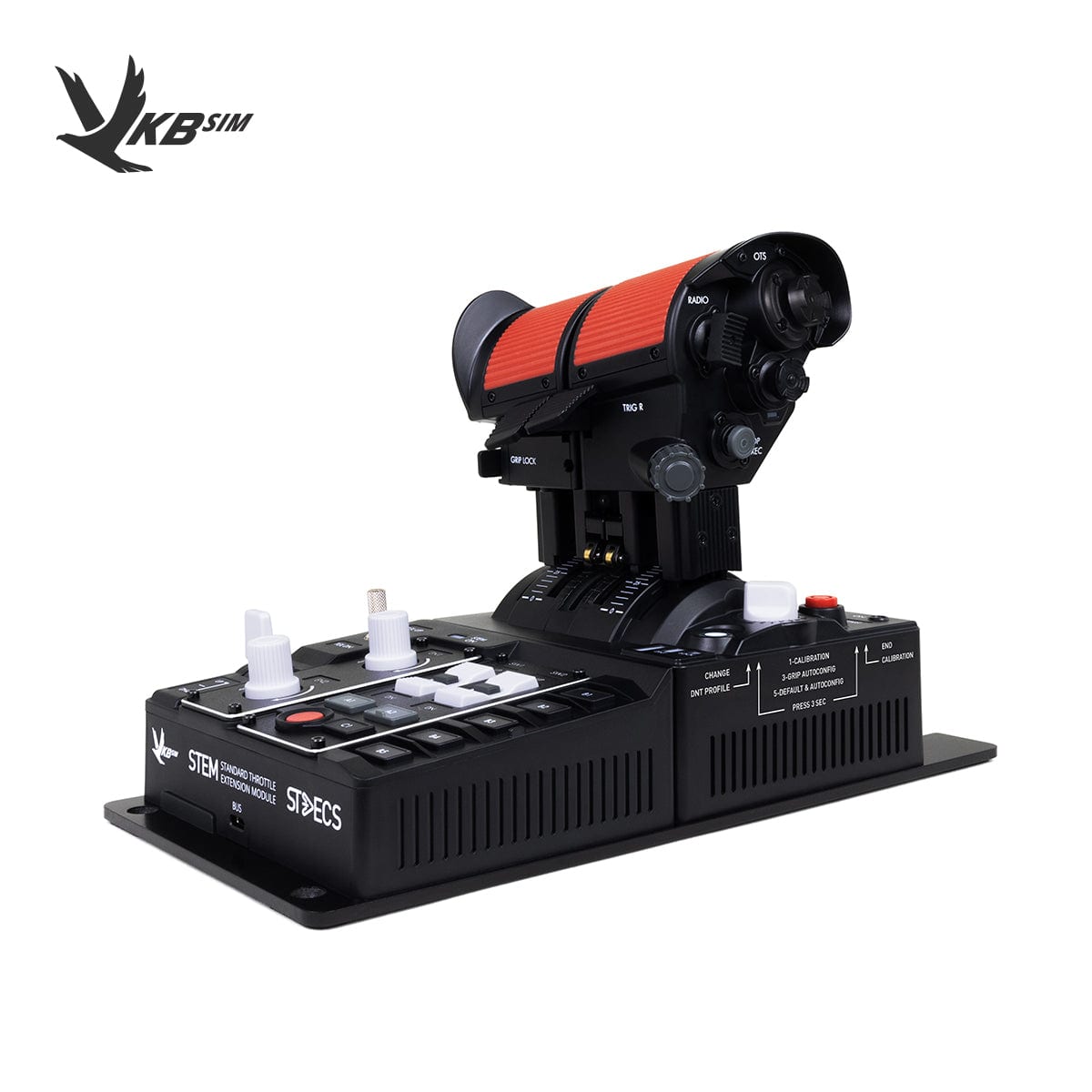
VKB STECS Standard Mini Throttle
VKB's compact hall-sensor throttle punches well above its $259 price point , boutique build feel without the boutique price tag.
Our Review
GearScout Score
8.9/10
Best for
DCS World pilots running multi-engine fixed-wing or attack aircraft who need a proper quadrant layout
8.9
Performance
9.1
Build
8.5
Comfort
8.9
Value
Our Verdict
Best hall-sensor throttle quadrant under $300 for serious sim pilots willing to learn VKB's software.
How We Tested
Tested over 14 days across DCS World (A-10C, F/A-18C, AH-64D), Microsoft Flight Simulator 2020 (IFR twin-engine long-haul), and IL-2 Sturmovik, running daily full-axis sweep stress tests to monitor hall sensor calibration stability. Compared directly against the Thrustmaster TWCS Throttle ($55) and the Virpil VPC Throttle MT-50 CM3 ($340) using identical binding configurations and the same cockpit mount setup.
Full Review
I picked up the STECS Standard Mini around the same time I was deep in a DCS World Persian Gulf campaign, running A-10C sorties back to back with a throttle setup that had started giving me sloppy axis readings on final approach. If you've ever had a potentiometer-based throttle drift mid-flight, you know the particular frustration of not being able to trust your own hands. That's the exact problem VKB is solving here, and they solve it with hall sensors and a modular metal-framed chassis that, when it lands on your desk, immediately communicates that someone in Rostov-on-Don took this seriously.
The spec sheet reads clean: hall effect sensors throughout the axis travel, a 23-button input count, a metal-and-plastic hybrid construction with the load-bearing parts staying metal, and full PC compatibility via USB. The "Mini" in the name refers to the form factor, not the feature set. Where a lot of throttles in this price range give you a single main axis and a handful of hats, the STECS Mini operates as a throttle quadrant, meaning you get multiple lever axes on a single unit that can be configured for twin-engine setups, prop pitch, mixture, condition levers, or anything else your sim demands. The modular design means VKB designed this to grow with you. Buy the mini now, bolt on additional modules later. That's a real commitment from a manufacturer, and it matters when you're deciding whether $259 is a platform purchase or a disposable one.
For testing, I ran the STECS Standard Mini alongside a Thrustmaster TWCS Throttle (street price around $55) and a Virpil VPC Throttle MT-50 CM3 (sitting around $340) over two weeks of daily use across DCS World, Microsoft Flight Simulator 2020, and a handful of IL-2 Sturmovik sessions. The DCS sorties covered the A-10C, the F/A-18C, and the AH-64D, each demanding different axis mappings and different tactile feedback expectations. MSFS testing covered IFR long-haul in a heavy twin, where friction feel and detent precision matter for managing two throttle levers over four-hour sessions. I also ran a deliberate edge-case stress test: full axis sweeps every session for 14 days straight to watch for any axis creep or center-point drift, the thing that kills potentiometer throttles quietly over time.
After 40 hours on the throttle, the hall sensors held calibration without a single recalibration pass. That's the baseline expectation from a hall sensor design, but it's still worth saying plainly because the Thrustmaster TWCS I was running in parallel needed two manual recalibrations inside the same window. The friction adjustment on the STECS Mini's lever is done via a tension screw, and dialing it in takes maybe three minutes with a 2mm hex key. Once set, it holds position without creep through sustained hands-off flight, which is exactly what you want when you're heads-down in the F/A-18C's radar page. The quadrant layout rewarded the A-10C setup in particular. Running left and right throttle on separate levers felt more natural than mapping both engines to a single axis split, and the physical separation between levers reduces fat-finger misses in high-stress moments like BFM.
The 23 buttons are distributed between hats, toggles, and a ministick that sits within thumb reach. In DCS bindings, I ran out of natural thumb positions before I ran out of buttons, which is a good problem to have at this price. The ministick is precise enough for cursor control in the F/A-18C's FLIR pod without making you feel like you're fighting it. The hat switches have positive click feedback with no mushiness, and the toggle switches feel like they came from an actual hardware parts bin rather than a toy drawer. The metal frame under the plastic trim panels does not flex when you push against the levers hard during a carrier trap or a full-deflection engine test. Chassis rigidity is something you stop noticing when it's right and can't stop noticing when it isn't. With the STECS Mini, you stop noticing.
The tradeoffs are real, though, and VKB won't put them in the product listing. First, the software. VKBDevCfg is functional but the interface looks like it was designed by firmware engineers, because it was. Getting custom curves, detents, and button logic configured requires patience and a willingness to read the manual twice. This is not plug-and-play in the way a Thrustmaster product attempts to be, and if you're coming from a console background or want zero-configuration setup, the learning curve is steep. Second, the "Mini" form factor means the total lever throw is shorter than the MT-50 CM3 or the Warthog throttle. For fine throttle control in turboprop aircraft where small power adjustments matter, the shorter throw is noticeable. Third, the desk clamp solution is adequate but not exceptional. Heavy-handed lever inputs can walk the unit on a smooth desk surface. A cockpit mount or a firm clamp to a board is the right long-term home for this throttle, not a bare IKEA desktop. Fourth, PC-only. No console support, no native Xbox input mode. That's fine for sim pilots, but it closes the door on anyone looking for a crossover device.
Compared to the Virpil MT-50 CM3 at $340, the STECS Mini gives up some lever throw and a slightly less premium friction mechanism, but it wins on price by $80 and loses almost nothing in day-to-day DCS usability. Compared to the Thrustmaster TWCS at $55, the gap is enormous in build quality, sensor longevity, and button count. The STECS Mini is the throttle I'd recommend to any sim pilot who has outgrown beginner hardware and wants a platform they can keep for five years. Paired with VKB's own Gladiator NXT EVO stick, you have a full HOTAS that competes with setups costing twice as much and occupies less desk space than most of them.
If you fly DCS seriously, run twin-engine fixed-wing aircraft in MSFS, or want a throttle quadrant that won't need replacing when you upgrade everything else, the STECS Standard Mini at $259 is the right buy. It's not the easiest throttle to configure and the desk mounting could be more robust, but the hall sensors, the modular chassis, and the 23-input layout represent genuine engineering decisions made by people who actually fly in simulators. That comes through in every session.
Hawk, Scout Gear Team
Best For
Pros
- Hall sensors held calibration across 14 days with zero drift
- 23-input layout covers all DCS module needs with buttons to spare
- Metal chassis frame eliminates flex under hard lever inputs
- Modular design allows axis expansion without replacing the base unit
- Friction tension screw delivers precise, stable lever resistance in under 3 minutes
Cons
- VKBDevCfg software has a steep learning curve for new users
- Shorter lever throw than MT-50 CM3 reduces fine turboprop control resolution
- Desk clamp walks on smooth surfaces under aggressive inputs
- PC-only with no console or native Xbox input support

Hawk, Scout Gear Team
Flight Sticks Specialist • 14 days of testing
May 26, 2026
View profile
Key Features
Specifications
Where to Buy
Compare prices from 4 retailers
Frequently Asked Questions
Common buyer questions about the STECS Standard, answered by Hawk